
Short answer first. If the coasters are headed to a craft fair table or out the door as a custom order, buy the MONKEY SUN slate blanks. If you are testing a design, building a jig, or you just need practice pieces you can ruin without flinching, walk into the hardware store and buy a box of ceramic tile. I have run both through my laser in the three years I have been engraving out of my garage, and they do not compete for the same job.
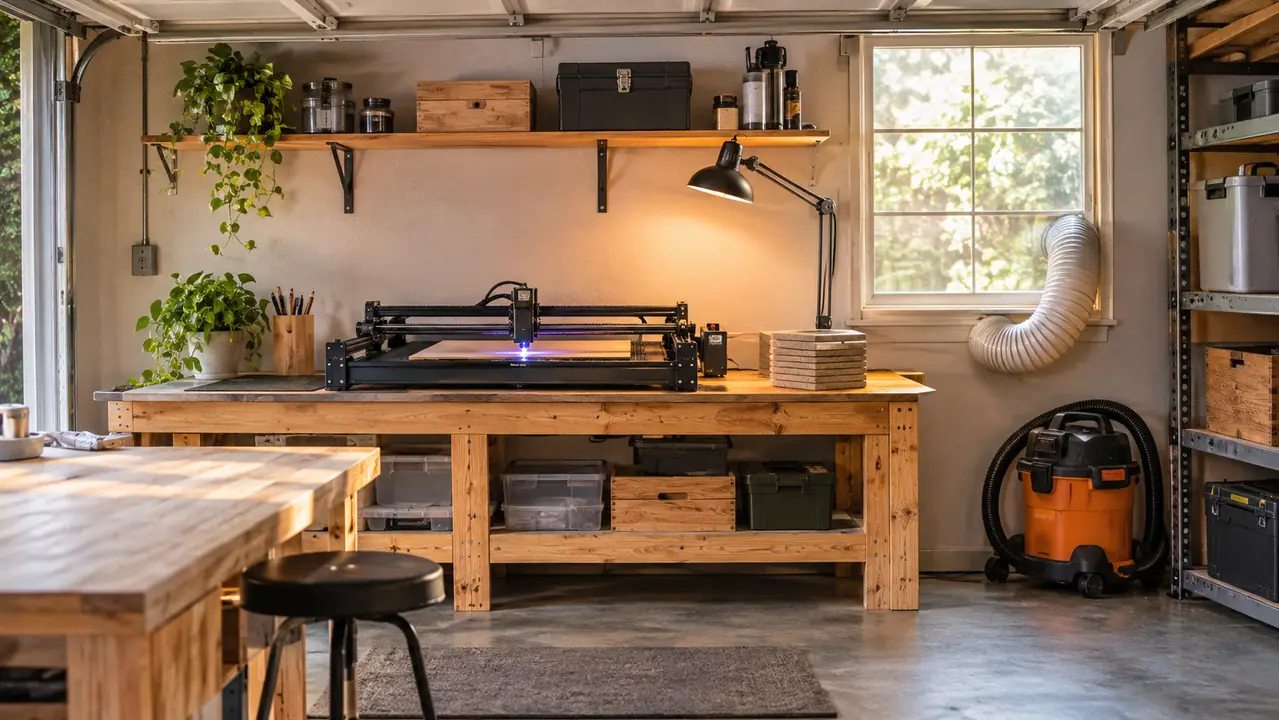
I am Lenny Sorensen. I retired out of HVAC work, and I keep a laser in the one-car garage behind the house, on the bench along the back wall. Most of what I sell is maple and walnut cutting boards, stainless tumblers, leather keychains and slate coasters, plus whatever Carol decides the church bazaar table needs that month. Slate became my default small item because it is flat, it is forgiving under the head, and it looks like something a person paid for. Hardware store tile became my default practice item for the opposite reasons.
| MONKEY SUN Slate Coasters | Hardware Store Ceramic Tile | |
|---|---|---|
| Ready to engrave | Comes out of the box as a finished coaster and goes straight onto the bed | A glazed face will not take a mark without a coating, and the glaze can flake where it is hit |
| Edge and finish | Handmade rough edge, so a chipped corner reads as rustic instead of ruined | Factory edge, and the cut sides need felt or a sanding pass before it looks like a gift |
| Size consistency | Natural stone, so thickness and edge vary a little from piece to piece | Uniform dimensions, which matters when you build a jig and run one file fifty times |
| Buying a small batch | Sold as a box of 60, which is the smallest order | Buy three pieces off the shelf if three is all you need |
| Replacing one broken piece | Reorder from the same listing and hope the batch matches the rest of the set | Drive over and buy one more the same afternoon |
| Care after the sale | Hand wash only, so you have to tell the buyer | Glazed tile wipes clean and tolerates a dishwasher |
| Engraving contrast | Slate goes light against dark stone with no post-finish and no clear coat | Unglazed bisque marks unevenly, and glaze needs a coating before it marks at all |
| Sizing options | 4 x 4 inch square | Many sizes and shapes on the same shelf |
| Best for | Gift-ready sets sold at fairs and by word of mouth | Practice, test plates and jigs |
How I Tested Both
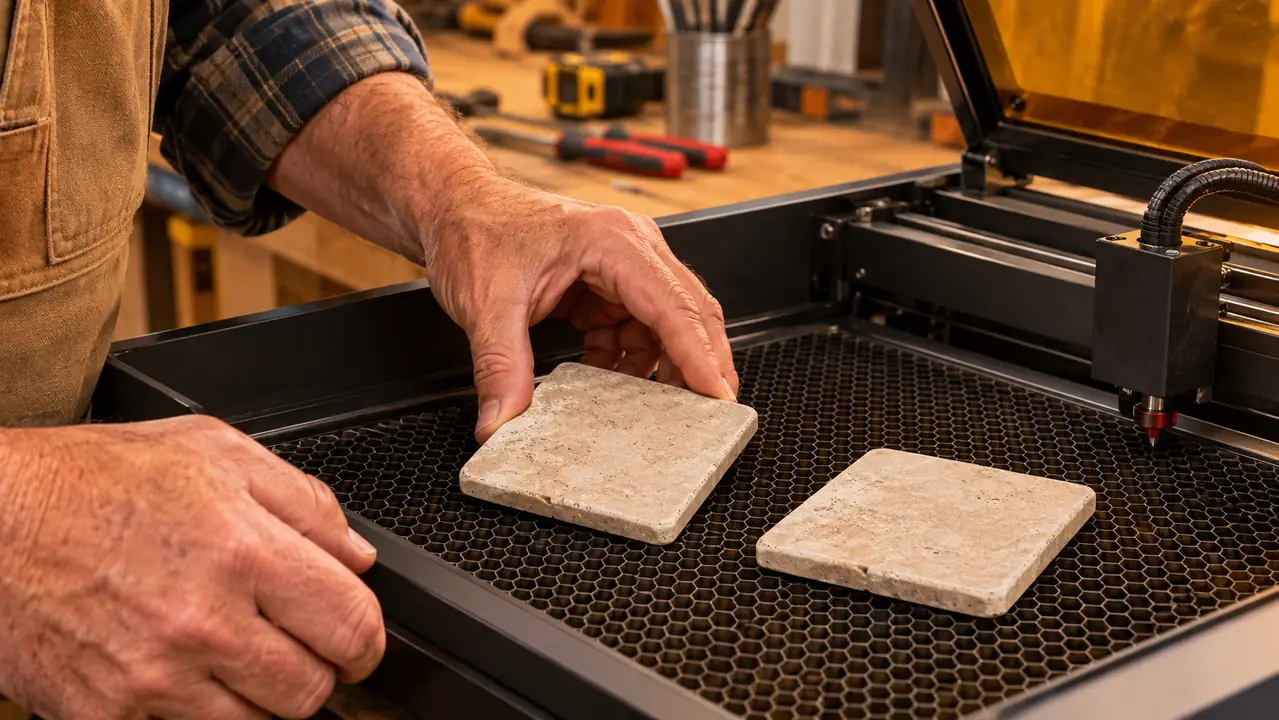
The tile came first, and it came by accident. I was in the hardware store for a bag of rags, walked past a shelf of four inch ceramic wall tile, and carried a box home to see what the laser would do to it. What it did was almost nothing. A glazed face throws the beam back and the mark wipes off with a thumb. Unglazed bisque takes a mark, but it comes out mottled, darker in one corner than the other, and the letters go soft at the edges.
The slate came second. I ordered the MONKEY SUN box of 60 to have something on hand for a spring fair, and the difference in my evening was immediate. I pulled the lid, set six pieces on the bed, ran the file, and they came off the machine looking finished. No coating, no rinse, no drying rack taking up half the bench. That is the whole argument for slate in one sentence, and the rest of this comparison is about the places where that argument does not apply.
For a fairer test I ran the same name and date design, about an inch and a half across, on thirty pieces of each over two evenings. I counted three things: how many came out saleable on the first pass, how much handling each piece needed after the laser stopped, and how many I threw out. The two evenings were not the same length, and that told me more than the finished pieces did.
The results were not close. On the slate, twenty eight of thirty came off the bed ready to wrap. The two that did not were my fault, one from a bad focus and one from a piece I set down crooked. On the tile, six were saleable after I cleaned the coating off, and most of those had a mark I would not put on a table at a fair. Both runs taught me something about my own process, which is the only reason I still keep tile on the shelf.
I ran that test in March, on a Thursday and a Friday, with the garage door cracked because the vent hose was working hard. The slate evening took me a little over two hours from opening the box to having thirty wrapped pieces stacked in a shoebox. The tile evening ran past four, and most of that extra time was drying, not engraving. I wrote the counts on a scrap of paper and taped it to the bench, which is how I know I am not remembering the tile more kindly than it happened.
Where MONKEY SUN Wins
The first win is time. A slate coaster goes from the box to the bed to the table, because there is no step in between that involves waiting for something to dry. With tile I had a spray step for the marking coating, a wait, a rinse, and a second wait before I could judge whether the piece was any good. Multiply that by thirty pieces and you have handed an evening to a process that produces nothing you can sell. I do this on weekends. Weekends are the whole operation.
The second win is the edge. Natural slate is cut by hand, so no two pieces are identical, and a rough edge is part of the look. When I chip a corner lifting a piece off the bed, which happens, it reads as rustic. When I chip a tile, it reads as broken and it goes in the bucket. Over a box of 60 that difference matters more than anything else in this article. I also do not have to explain to a buyer why the piece looks the way it does, because the piece looks like stone.
The third is the material itself. Slate takes a clean mark and holds it, light against dark, with no post-finish and no clear coat over the top. I have coasters from my first month of engraving, pieces that have sat on outdoor tables at fairs and been wiped down at kitchen sinks, and the design is still there. That matters when your orders come from neighbors and repeat customers, because a piece that fades is a piece that stops the referral.
One thing I did not expect was the thickness. It varies enough that I check each piece under the head before I start, and my focus height is set per piece rather than per batch. That sounds like a nuisance and it is one, a little. But the payoff is a box that holds a range of pieces, some a hair thicker, some with a wider rough edge, and when I lay six finished coasters out on the table they look like a set of stone instead of a set of copies. Buyers pick through the stack and take the ones that catch their eye.
Sixty blanks in one box means a full Saturday batch without a reorder, and a rough edge means the one piece I chip still goes on the table.
Where Hardware Store Tile Wins
Tile wins on practice, and it wins big. When I am learning a new file, changing a lens, or dialing in a speed for a material I have not run before, I do not want to burn a slate blank on a guess. I want something flat, plain, and available in a stack by the register. Tile is that. If I ruin six pieces working out a hatch pattern, I have learned what I needed to learn and lost nothing I care about. That is a real job, and slate is the wrong tool for it.
It also wins on flexibility. Tile comes in sizes and shapes that slate blanks do not, and I can buy three pieces or thirty. When a customer wants a trivet instead of a coaster, or when I need a flat plate to sit under a jig, the shelf gives me options that a fixed box of 4 x 4 squares does not. And when I break a piece in a set that is already spoken for, I can drive over and buy one more instead of waiting on a reorder that may not match the batch I started with.
Concrete case for that: I built the jig I use for tumbler wraps last fall out of a piece of tile I had already ruined on the front face. It is a flat plate with two strips of wood glued down at an angle, and it holds the wrap steady while the laser runs. That plate lives on the shelf, gets glue on it, and does not need to be pretty. Had I used a slate blank for the job, I would have spent a saleable coaster on a tool.
The last one is care. Glazed tile wipes clean and goes in a dishwasher, and I do not have to add a note to the wrapping telling anyone otherwise. Slate is hand wash only, and if I forget to say that at the table, I will hear about it later from someone whose coaster went through the machine and came out with a dull spot where the design used to be.
The blanks that come off the bed ready to sell
I keep the MONKEY SUN box next to the laser so a Saturday run starts with design work instead of prep work. Sixty 4 x 4 inch slate pieces, rough natural edge, straight onto the bed with nothing sprayed on top.
Amazon Check Today's Price on Amazon →
The Prep Work Nobody Mentions
A diode laser will not mark a glazed surface without something on top to absorb the beam, and that coating is another purchase, another surface to keep clean, and another thing to run out of on a Friday night before a Saturday fair. A CO2 laser does better on unglazed bisque, but it still gives you a mottled result that depends on how the tile came out of the kiln. Either way you are doing a spray or a brush step, and you are doing it for every single piece in the batch.
The other thing is the back. Slate has enough weight and texture that it sits on a table without help. Tile does not, so you end up cutting felt or cork for the bottom of every piece so it does not scratch the furniture it was bought to protect. That is another material, another template, and one more thing to be short of when you are packing the truck.
Storage is the small thing I did not think about until the second box. Slate arrives with cutting dust on it, and I wipe each piece down before it goes on the bed or I am engraving through a film of grit. The box lives on the lower shelf with the lid on, because a stack of loose stone in a garage that also holds a shop vac collects whatever is floating in the air. Fifteen minutes with a rag gets a whole batch ready, and I do it while the machine is warming up.
And the slate side deserves an honest note too. It is a natural material, the edges are rough on purpose, and every piece is a little different. A buyer who wants four identical coasters in a stack will notice. I say that up front now, that the variation is the point and no two will match, and I have never had a set handed back to me. But you do have to say it.
Who Should Buy Which
Buy the MONKEY SUN slate box if you are already selling small items and want one less process between a design and something a stranger will pay for. It suits craft fair tables, church bazaar tables, custom sets for neighbors, and gift orders where the buyer is going to turn the piece over in their hands. Sixty pieces is a real batch. It will carry several weekends of orders before you think about a reorder, and the pieces you chip along the way stay in the saleable pile.
Buy the hardware store tile if you are still learning the machine, if you need a one-off plate for a jig, or if you want a large flat surface in a size the slate blanks do not come in. Buy it to practice on, not to sell. The first time you hand a customer a piece of glazed tile with coating residue in the corner, you will understand the difference between a blank and a finished product.
Where I landed after a season of running both: tile in the scrap bin for testing, slate in the box for anything that leaves the garage. That is not a knock on tile, and I will keep buying it. It is just that only one of these two arrives as a coaster.
Start the next batch with pieces that are already coasters
Sixty square slate pieces, 4 x 4 inch, handmade rough edge, hand wash only. It is the item I reorder before fair season instead of after, because the box does the finishing work for me.
Amazon See the current price on Amazon →