
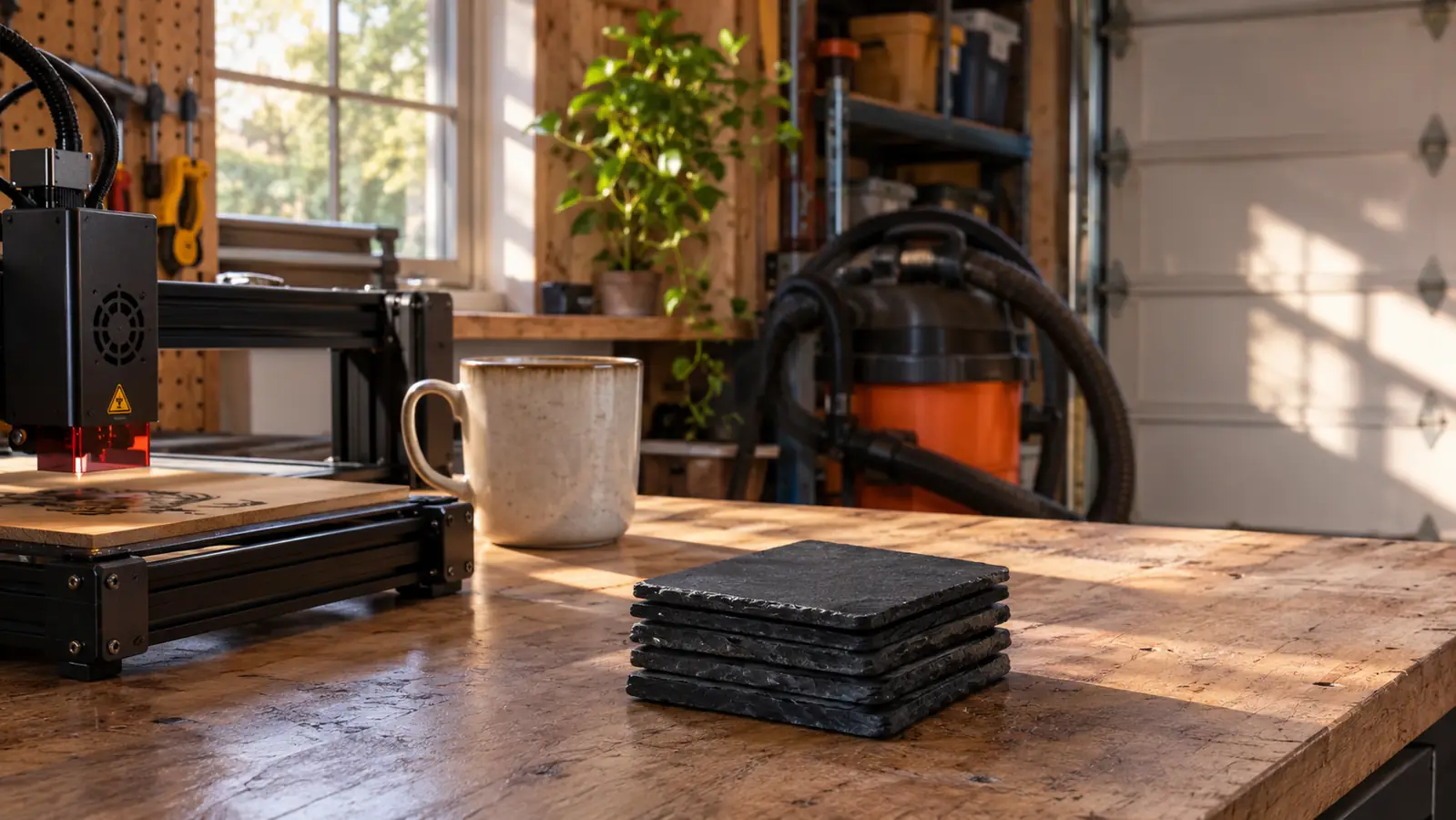
The first box of slate blanks I ever bought arrived with four broken coasters stacked on top like an apology. That is the unglamorous risk of buying stone through the mail, and it is the first thing I check now. So when the MONKEY SUN 60 pack landed on my bench, I did what I do with any new blank: cleared the work surface, laid twenty of them out in a row, and ran my thumb along every edge before the laser ever fired.
I have been engraving out of the detached garage behind my house outside Harrisburg for about three years. Slate is the item that carries my table at church bazaars and the local craft fairs, partly because a coaster has enough weight in the hand to feel like an object and partly because a bad one costs me a blank instead of an evening. Carol picks the designs. I do the cutting, the cleanup and the packing. This is the pack that has stayed on my shelf.
The Quick Verdict
A dense 4 x 4 inch square slate blank with a natural rough edge that engraves cleanly and packs well, as long as you expect a few chipped corners out of sixty and never let one near a dishwasher.
Amazon Check Today's Price →Sixty blanks is enough to find out whether slate belongs on your table
4 x 4 inch natural slate, square cut, rough edges already where the design wants them. Hand wash only, so tell your customer that part before they find out the hard way.
Amazon Check Today's Price on Amazon →How I've Used It
I have bought this pack twice. Between the two boxes I have engraved somewhere north of ninety coasters, most of them in sets of four, the rest as singles for neighbor orders. A set of four is what sells at a bazaar table, so most of my work is repeat designs: an initial with a small silhouette, a pair of names and a date, a simple line drawing of a barn or a pine tree. Nothing fancy. Fancy is what gets you a chipped corner and an unhappy customer.
The routine in my garage is not complicated. Every blank gets brushed off and then wiped with a damp cloth before it goes under the beam, because the slate dust from the cut edges settles into the carve and dulls the contrast. I use a small jig I built from two strips of scrap plywood to square each coaster up under the laser, and I do not mask slate. The residue vacuums off with a shop vac and a soft brush, and there is no weeding to do afterward.
The pack holds up to that routine. Sixty blanks means I can sort them, set the uneven ones aside for bold designs, and still fill an order for six sets without digging into the next box. That sorting step matters more than it sounds like it should, and I will get to why.
What Actually Comes in the Box
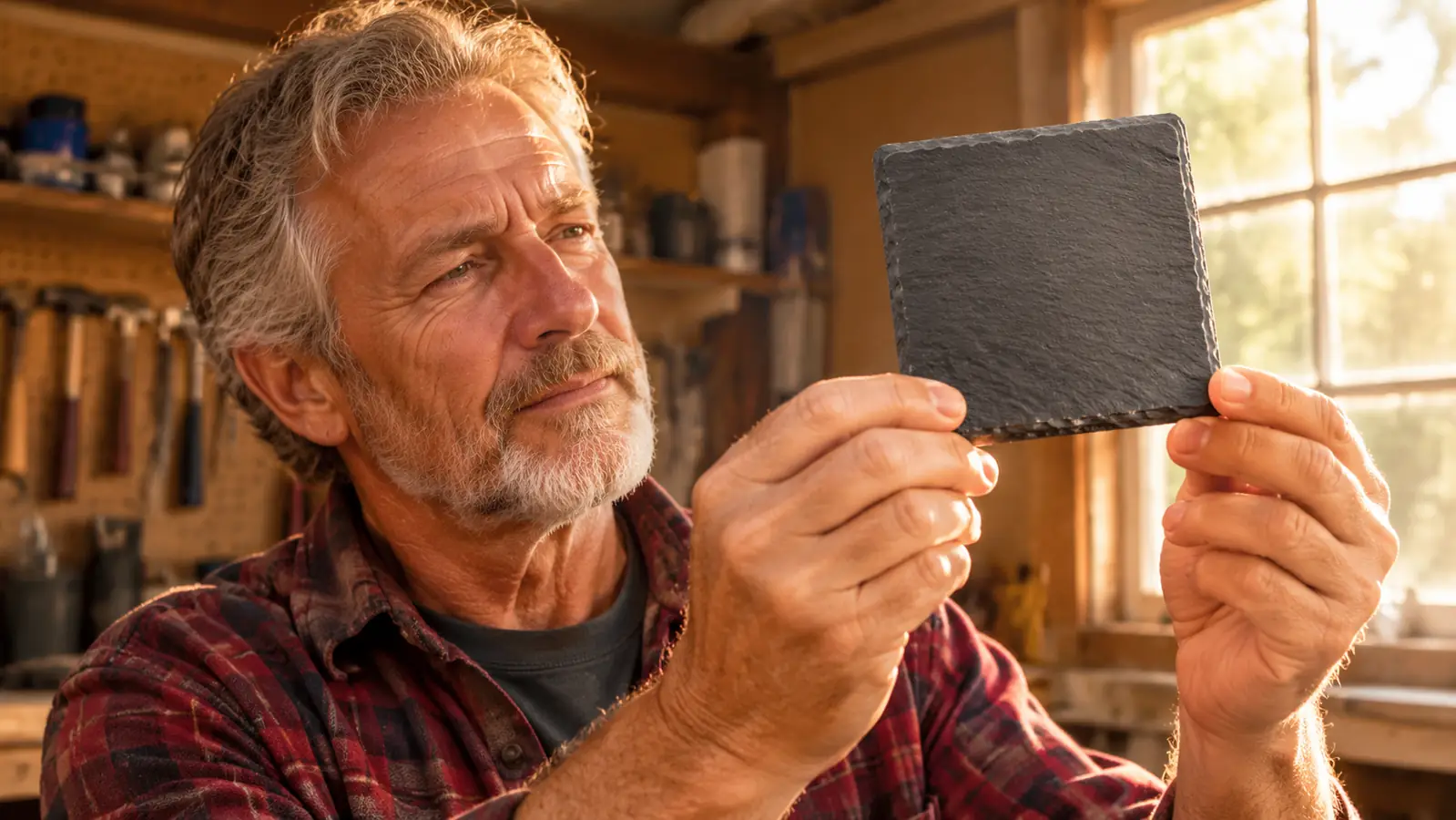
The MONKEY SUN box holds sixty coasters, square, 4 x 4 inches, cut from natural slate with a rough edge left on the perimeter. The square cut is consistent enough that the jig I built for the first box still lines up on the second one. That sounds like a small thing until you have spent an afternoon re-centering a design on blanks that are all a quarter inch different from each other.
Slate splits in layers, so no two blanks are the same thickness. That is the nature of the stone and not a defect in the pack, but it does mean you have to pay attention. I sort every box into two piles. The flat, even pieces go to designs with fine text and thin lines. The thicker, more uneven pieces go to bold silhouettes where a slight dip in focus will not show. Skip the sorting, feed them in whatever order they come out of the box, and you will get a handful of carves that go soft at one corner. Then you will blame the machine, and it was not the machine.
They arrive dusty. A dry brush first, then a damp cloth, then a few minutes of drying before they go under the beam. The listing says hand wash only and that is honest advice rather than corporate caution. The stone is laminated by nature, and a dishwasher will push water between the layers and start the whole thing coming apart.
How the Slate Takes a Laser
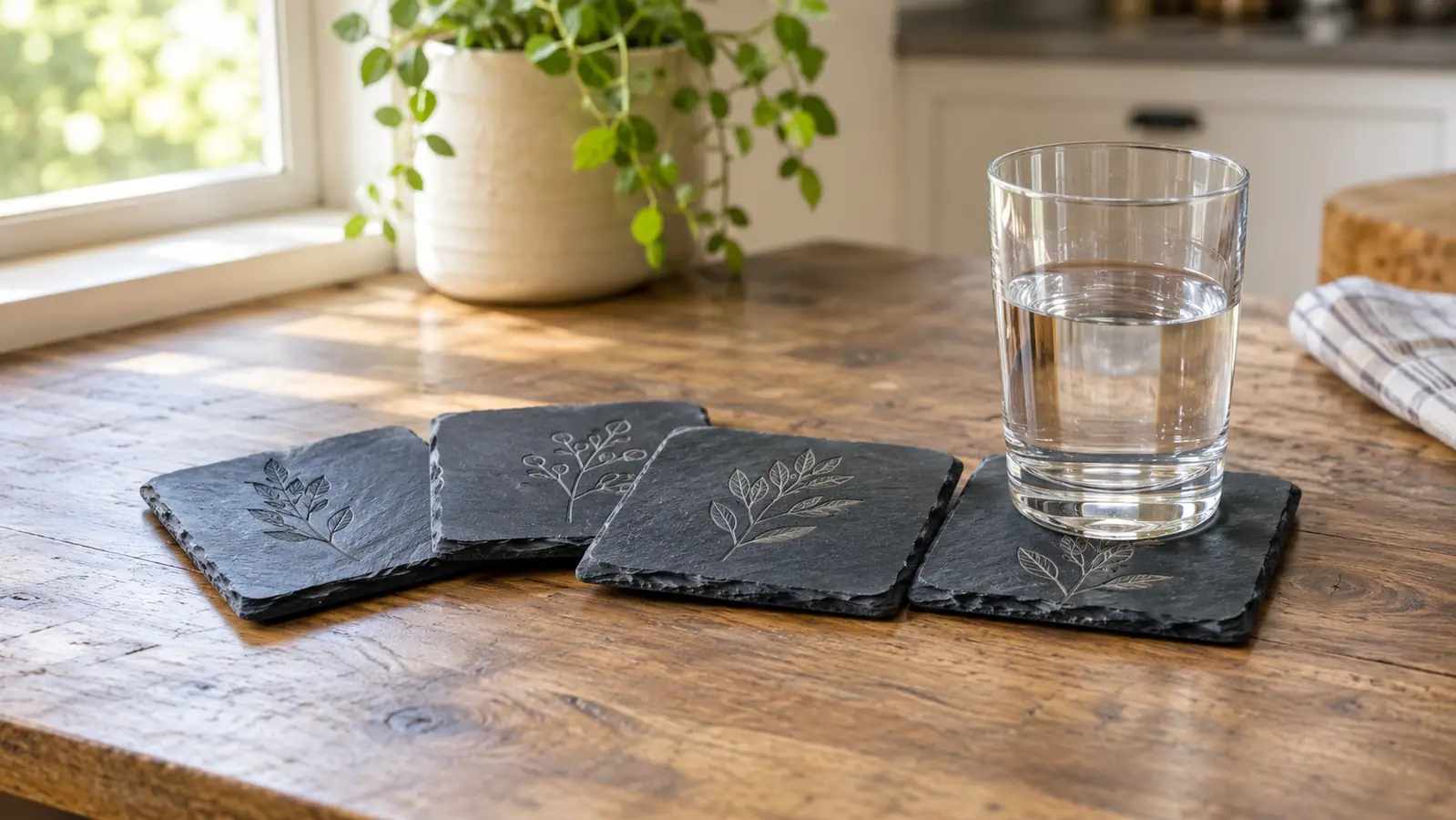
Slate is one of the more forgiving materials I engrave. The beam takes off the top surface and what is left behind reads much lighter than the surrounding stone, so a design shows up with no paint, no filler and no second pass. If you have ever fought a material that needed a coat of something to make the design visible, you will appreciate how little work this one is.
I run a modest diode laser at a speed and power I have settled on across a few hundred coasters. The setting that works for me gives a flat, even carve with almost no scorching at the edges. The rough perimeter is what changes your layout. On a blank with a clean machined edge you can push a design closer to the border. On this one you want to stay back about an eighth of an inch, because a carve that runs into the rough edge will chip out and leave a gap in your line.
Fine serif type under about ten point starts to crumble on slate no matter what you do. That is a limitation of the material, not of this pack. All caps, heavier weights and simple line work all hold up. A name in a bold sans-serif at a decent size comes out clean, and a small date underneath it stays legible if you keep the strokes thick enough to survive the carve.
The Rough Edge Is the Point, and Also the Problem
The rough edge is why people pick these up at a fair. A coaster with a machined edge looks like something from a restaurant supply catalog. One with an uneven rim looks like it came off a workbench, which it did, and that is the whole appeal of a handmade table. Buyers run their thumb along that edge before they decide anything.
The trouble is that the same edge is where the damage happens. Out of my first box, three arrived chipped at a corner. Out of the second, two. That is five out of a hundred and twenty, which I consider acceptable for stone shipped through the mail, and I did not send any of them back. The chipped ones went into my own kitchen and nobody has ever commented on them. But if a neighbor orders a set of four, I am not handing over one with a broken corner, so those blanks come straight out of my count.
I knock the sharpest points off every edge before a coaster goes to a customer. A few light passes with 220 grit on the worst spots, just enough that it will not scratch a table. I do not sand the edge smooth, because the roughness is what sells it. I am only taking off the burrs that would catch on a cloth.
Hardware Store Tile Was My First Try
Before I ever bought a box of blanks I was cutting hardware store floor tile on the same machine, because it was there and I was learning. It worked well enough to teach me the settings. It did not work well enough to sell. The tile is thinner, the edges are machined square, and the finished coaster has a hollow sound when you set it down on a table. I wrote up that comparison separately if you want the longer version, because it is the question every beginner asks me first at a fair.
The short answer is that floor tile is a fine way to practice and a poor way to build a table. These blanks are heavier, the rough edge does half the design work for you, and a stack of them on the bench looks like inventory instead of leftovers from a bathroom remodel. That difference matters when someone is deciding whether to hand you folding money at a church bazaar.
There is a second reason I stopped cutting tile. It chips in a different way. Floor tile fails in long cracks across the face, usually while it is cooling, and it fails on the pieces you have already spent twenty minutes on. Slate tends to fail early, before the carve, which is a much cheaper way to lose.
Breakage, Cleaning and a Season on the Table
Over two boxes I have lost five blanks to a chipped corner in transit, and two more cracked in the laser from a hidden fissure in the stone. Slate has faults in it and there is no way to see them from the outside. If you are cutting a set of four and one of them cracks mid-carve, you cut a replacement and move on. That is the real argument for buying sixty at a time. I always have a spare that matches the batch, so a set stays consistent.
Cleaning is a damp cloth and a dry towel. I have had coasters come back to the table after a full day of being handled by fifty people, and they wipe down fine. I do not soak them, and I tell every customer the same thing when they buy a set: wipe, do not soak, keep it out of the dishwasher.
One thing I add myself: a thin cork pad on the back of every coaster I sell. It keeps the stone off a wood table and it heads off the scratching complaint before it happens. The pad goes on with a dab of contact cement while the front is drying. That is not something in the box, just part of how I finish a set.
Packing is where the rough edge makes you work. Four coasters stacked loose in a kraft box will rub against each other inside a tote bag, so I wrap each one in a strip of tissue and put a square of thin foam between the layers. A chipped corner that happens in my own tote bag is still a chipped corner I have to explain to somebody.
Setup Notes for a First Box
If this is your first run at slate, three things will save you a Saturday. First, vent. I cut with the garage window open and the shop vac running next to the machine, and I still give the garage ten minutes to clear before I pull my safety glasses off. Slate dust is fine and it gets everywhere.
Second, build a jig before you carve anything you care about. Two strips of scrap plywood screwed to a spoil board, set at a right angle, is all it takes. Drop the coaster into the corner, hit start, and every design lands in the same place. Without it you will nudge each blank into position by eye and your carves will walk around the face from one piece to the next.
Third, burn a test on a blank you already plan to keep. The first coaster out of every new box is mine, not a customer's, and I set it beside the rest so I can see how the batch is taking the beam. Takes ten minutes. Saves the four coasters you would have cut before noticing that the power setting was off.
What I Liked
- Square 4 x 4 inch cut holds a consistent jig from box to box
- Natural rough edge reads as handmade on a craft fair table
- Engraves to a clean, high-contrast carve with no paint or filler
- Sixty to a box, enough to cover a full weekend of orders with spares
- Dense stone with real weight in the hand, which reads as value to a buyer
Where It Falls Short
- A few arrive with chipped corners, three and two in my two boxes
- Thickness varies enough that fine text requires sorting first
- Hand wash only, so no dishwasher and no soaking
- Rough edges need a light knock-down with 220 grit before selling
- Dusty straight out of the carton and they need a wipe before use
Five chipped corners and two cracked blanks out of a hundred and twenty is a better ratio than any other boxed slate I have bought, and the sorting is what keeps the other hundred and thirteen clean.
Who This Is For
This pack suits someone running a small engraving setup who wants a finished-looking product without a finishing step. If you are doing sets of four for craft fairs, church bazaars, neighbor orders or a small online listing, sixty square blanks at 4 x 4 inches is about the right size of commitment. It is enough to learn the material, waste a few, and still have a full table on Saturday morning.
It also suits anyone already selling wood or acrylic and looking for a heavier item to sit next to it. A slate coaster has weight, and weight reads as value on a folding table. The MONKEY SUN blanks photograph well too, because the rough edge catches light and you do not have to stage anything to make them look like a craft item.
And it suits the beginner who has been cutting scrap and wants to see what a real blank does. Sixty pieces is a classroom. You will make your mistakes on the first ten and sell the last forty.
Who Should Skip It
Skip it if you need a uniform edge. If a design depends on a perfect square silhouette, or you are making something that has to stack flush, the natural rough edge will fight you on every piece. Buy a machined blank instead and accept that it looks machined.
Skip it if a dishwasher-safe product matters to the person buying from you. This is a hand wash item and the listing says so. And skip it if you only need four coasters for your own kitchen. Sixty is a working quantity, not a sampler, and you will be storing the rest of the box for a good while.
If slate is going to be your bazaar item, buy enough to learn on
4 x 4 inch natural slate, square cut, rough edge, hand wash only. Buy the box once, sort it on the bench, and you have a season of sets with spares built in.
Amazon Check Today's Price on Amazon →