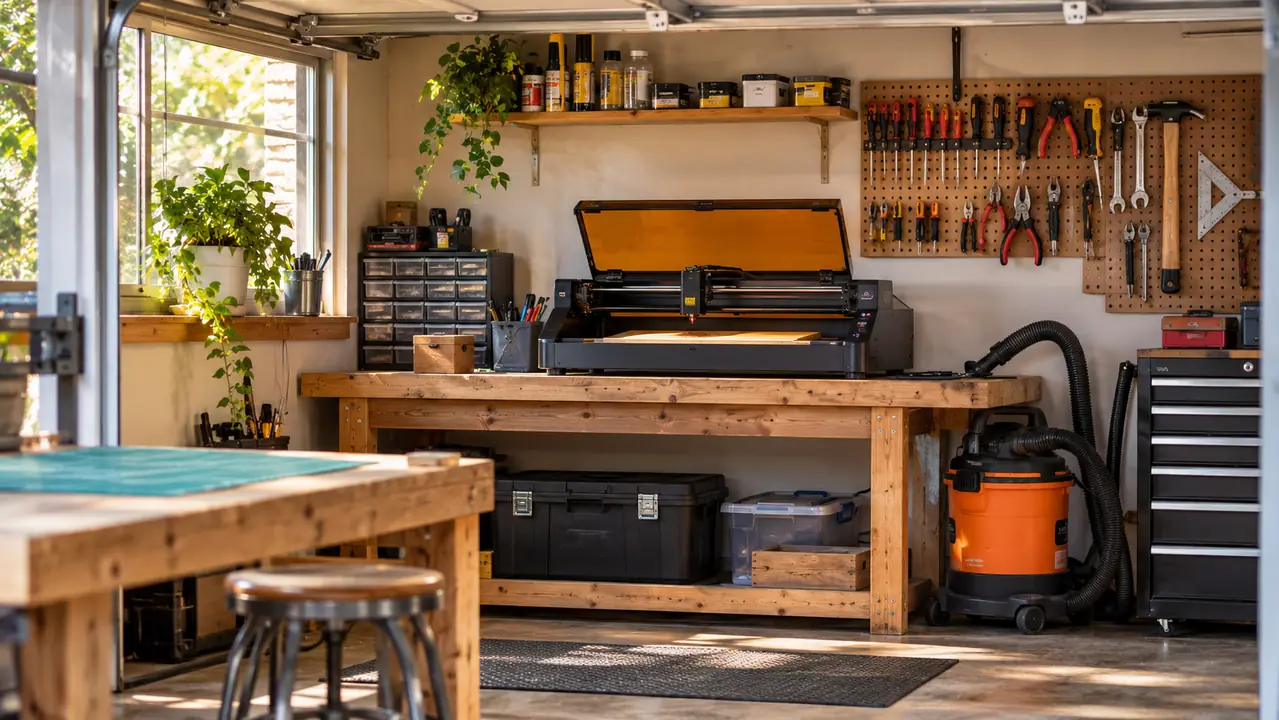
Three years into this hobby I have learned that the machine matters less than the hours you put on it. My setup is one bench along the back wall of a one-car garage, one window I vent through, and one shop vac that lives under the bench and never gets put away. When the Twotrees TTS-10 Pro arrived it did not get a welcome party. It got bolted together on a Saturday morning and put to work that afternoon on a stack of maple boards I had been sanding all week.
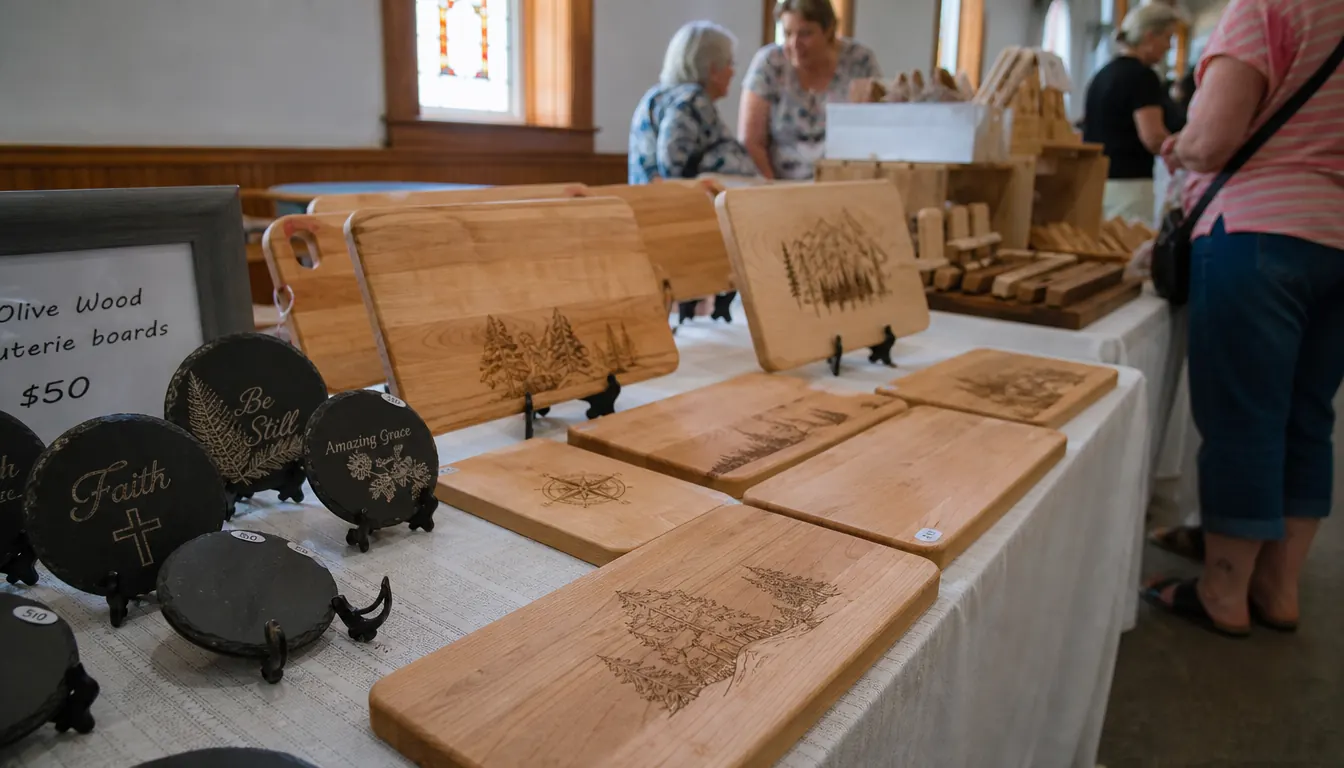
I have run it most weekends since, through a church bazaar and a long stretch of custom coaster orders from neighbors. So this is a review written from months of weekend use, not a bench test and not an unboxing. I am not going to quote order counts at you or tell you what a machine like this will do for your income. I will tell you what it did on my bench, with my materials, and where it made me change how I work.
The Quick Verdict
A 10W diode laser with a 300 by 300 mm work area that earns its bench space on cutting boards, coasters and tumblers. Buy it if you have a garage, an outlet, and the patience to set it up once. Skip it if you need to cut thick stock or haul a machine to shows.
Amazon Check Today's Price →A 300 by 300 mm work area is the reason this one never gets folded away
The TTS-10 Pro engraves hardwood, slate and coated tumblers at a hobby pace, and the air assist pump ships in the same box. See the current listing and the full spec sheet.
Amazon Check Today's Price on Amazon →How I've Used It
I put it together on the bench with the assembly tools that came in the box. The air assist pump and its tubing took a second pass at the instructions, and that was my own fault for not reading the diagram first. Everything else went together in an afternoon. Give yourself the afternoon. A laser that sits crooked cuts crooked, and setup is the part you only have to do once.
Since then it has run maple, walnut, slate, leather and coated stainless tumblers. A normal Saturday is two cutting boards in the morning and a batch of coasters in the afternoon, with the shop vac going between jobs. I load files from the 4GB TF card that ships with the machine, using the card reader from the same box. It is not a fancy workflow, but it is one I can repeat with a cup of coffee in my hand.
The first real job was a walnut board for a neighbor's anniversary, run on a Sunday afternoon in the fall. I had the design sized wrong and the burn landed an inch and a half high, so I sanded the whole face back down and started over. That was the afternoon I learned to lay the design out on the board in pencil before I ever open the file. Two hours lost, and worth it.
The machine is corded electric and runs on 24 volts, so it lives where the outlet is. That has not been a problem for me, because the garage is where I work. It does mean you should plan your bench around the machine rather than planning to move the machine around the bench.
What surprised me is how it changed the orders I say yes to. Before, a request for a set of eight coasters meant a long evening. Now I lay them out in one grid, start the job, and do something useful while it runs. That is not the same as owning a bigger machine. It is the work area doing its job, and it is the reason the Twotrees TTS-10 Pro stays set up instead of getting folded away between projects.
The 10W Diode and What It Actually Cuts
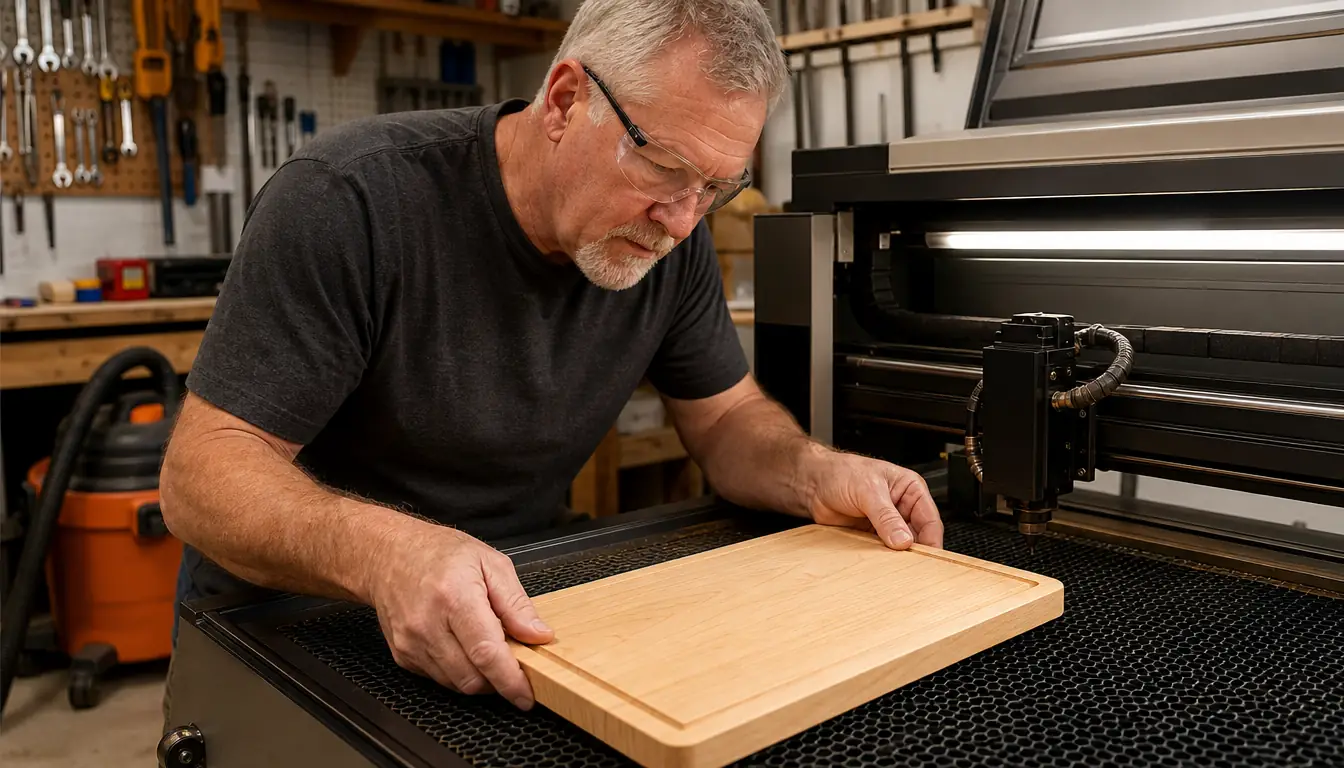
The head is a 10W optical output diode, 450nm blue light. The number that matters is optical power, the light that actually reaches the work, not the wattage pulled from the wall. Ten watts of diode light engraves hardwood well and cuts thin stock. It does not turn a garage into a cabinet shop, and anyone telling you otherwise is selling something. If you have been told a diode laser cannot do real work on hardwood, that has not been my experience.
On hard maple I get a clean, dark engraving on one pass for most of my designs. Deep carving on walnut takes a second pass if I want the burn to sit below the surface. Slate takes it well, and leather keychains are quick enough that I can do a dozen in an evening. Coated stainless tumblers are the one material where I slow down and test on a spare first, because the coating varies batch to batch and I have ruined a tumbler by assuming it would behave like the last one.
My test grid is nine small squares, three power settings by three speed settings, burned onto a corner of the same material I am about to run. On a maple board I cut the grid on the back face where the customer will never look. On a tumbler I cannot do that, so I keep one ruined tumbler from each supplier on the shelf and use it as my test piece until the coating changes. It sounds fussy. It has saved me more tumblers than it has cost.
The 300 x 300 mm Work Area in Practice
The work area is 300 by 300 mm, roughly 11.8 inches square. For my work that is the whole story. A standard maple cutting board fits inside it with room to spare for the design I run, and I can lay out a grid of slate coasters and let the machine work through them in a single sitting. Small wooden signs, the kind that sell at a church bazaar for a shelf, fit comfortably. I have run six coasters and two small signs in one afternoon without touching the setup except to swap material.
Where it pinches is anything bigger than a small sign. There is no pass-through and no expansion, so a long board means repositioning and lining the second half up by eye. I have done it. I do not enjoy it. If your plan is big wall signs, plan on a different machine or plan on splitting the design. Measure your biggest blank before you buy, because that measurement is the whole decision with a machine this size.
The one big sign I tried was a two foot pine board for a neighbor's shed, and I split the design down the middle with a registration mark burned into both halves. It worked, but the seam was visible if you looked for it, and lining up the second half took me three tries before I was happy. These days I quote that kind of job with a warning attached, or I turn it down and point the neighbor at a shop with a bigger bed. Knowing what your machine will not do is part of running it well.
Six slate coasters, one grid, one run, and every one of them clean enough to put out on the table at the church bazaar.
Air Assist, the Mainboard, and the Small Stuff in the Box
The air assist pump and tubing come with the machine, which I did not appreciate until I ran a job without it. The pump puts a stream of air on the spot where the beam meets the wood. Smoke clears, the lens stays cleaner, and the edges of the burn come out sharper. On slate the difference is obvious. Having it in the box instead of on a separate order is one of the better calls Twotrees made here.
The mainboard is a 32-bit dual-core unit, and Twotrees advertises faster processing as the benefit. What I can tell you is what I see: files load and the machine starts without the pause I used to get on an older setup, and I have not had a job stall halfway through. That is a low bar and a real one. The rest of the box holds the 4GB TF card, a card reader and the assembly tools. There is no enclosure in the box, so venting through the window and a pair of safety glasses are on you. Twotrees covers the machine with a one year warranty.
Where It Fell Short
Fair is fair, and three things cost me more evenings than they should have. The first is getting the frame square. Mine did not arrive square, and if you rush that step the machine will happily engrave a rectangle that comes out as a trapezoid. I learned it on a slate coaster order and redid four pieces. Take a square to the frame before you run anything you care about, and check it again any time you slide the machine along the bench.
The second is material settings. No chart knows your walnut. Every board from a different supplier burns a little differently, and the only fix is a test grid on scrap from the same board. I keep a notebook now with the settings that worked for each supplier and each thickness. It is not glamorous, but it stopped me from ruining good stock, and it is the habit that separates a nice afternoon from a wasted one.
The third is smoke. The air assist moves it away from the cut, but it does not remove it from the garage. I vent through the window with a box fan and I still open the garage door when I am running slate, which puts out more smoke than wood does. If your space is a basement or a spare bedroom, this is the part of the decision that should slow you down. An enclosure with real filtration is a separate purchase and, in my opinion, the first thing worth adding.
There was one evening in January where I ran slate coasters with the garage door closed because it was fifteen degrees out, and I regretted it inside of ten minutes. The smoke hung at eye level and I shut the job down, opened both doors, and let the garage air out before I restarted. Since then the door stays cracked no matter what the thermometer says, and I keep a cheap box fan in the window pulling air out rather than pushing it in.
What It's Like Week to Week
My routine is short. Wipe the lens, blow the rails out with the shop vac, check that the frame is still square, and run a small test burn on scrap before the first real job of the day. Ten minutes, maybe. The machine has not given me a reason to do more than that, and the one time I skipped the test burn I wasted a good piece of walnut on a design that had shifted.
Most of my orders come from neighbors and from the table at the bazaar, and they arrive in clumps. A school wants twelve keychains for a fundraiser. Someone down the street wants a cutting board with a family name burned into it. The machine handles a clump better than a single fussy piece, because the setup time is the same either way and a batch is where the hours pay off.
The noise is the pump and the shop vac, not the laser. I run it with the garage door cracked and the window open, and in a Pennsylvania winter that means I dress for it. This is a hobby that happens in the cold months too. The diode does not care about the temperature. Your fingers will. And if something does go wrong, it is usually the file and not the machine. Every stall I have had traced back to a design with a stray line in it.
What I Liked
- 300 by 300 mm work area fits a cutting board or a full batch of coasters
- 10W optical diode engraves hard maple and walnut without a fight
- Air assist pump and tubing included, so clean edges from the first job
- 32-bit dual-core mainboard loads files without the stall I expected
- 4GB TF card, card reader and assembly tools all in the same box
- Covered by a one year Twotrees warranty
Where It Falls Short
- Corded and 24 volts, so the machine stays where the outlet is
- You square the frame yourself, and a crooked frame shows up in every job
- No enclosure in the box, so venting and eye protection are your problem
- 300 mm square rules out big wall signs and long boards
- Coated tumblers still need a test burn on a spare before a batch
- Slate puts out more smoke than wood and needs a door open
Who This Is For
If you are setting up in a garage or a spare room and your projects are cutting boards, coasters, tumblers, leather patches and small signs, this machine covers the whole list. It suits a beginner who will spend an afternoon on setup and ten minutes before each session on a test burn, and it suits someone moving up from a smaller diode who wants more room on the bench and an air assist already included. It also suits a craft fair seller who runs a batch of coasters on Friday night and packs the car on Saturday morning.
What I would not do is hand this to someone who wants to press a button and get a finished product. The machine is half the work and the other half is you, your materials and your notebook. If that sounds reasonable rather than discouraging, you are the right kind of owner for it.
Who Should Skip It
Skip it if you need to cut thick stock, if you want an enclosed machine with filtration built in, or if your designs run larger than a small sign. Skip it if you plan to haul the laser to shows, because it is corded and it is not light. And skip it if you are not willing to square a frame and learn your own material settings, because no machine in this class arrives knowing your walnut. That last one is the honest dividing line, and it has nothing to do with the brand.
If your projects fit inside 300 mm square, this one earns its bench
Months of weekend use on cutting boards, slate and tumblers. Twotrees ships the air assist, the card and the tools in the same box, and the warranty runs a year.
Amazon Check Today's Price on Amazon →