
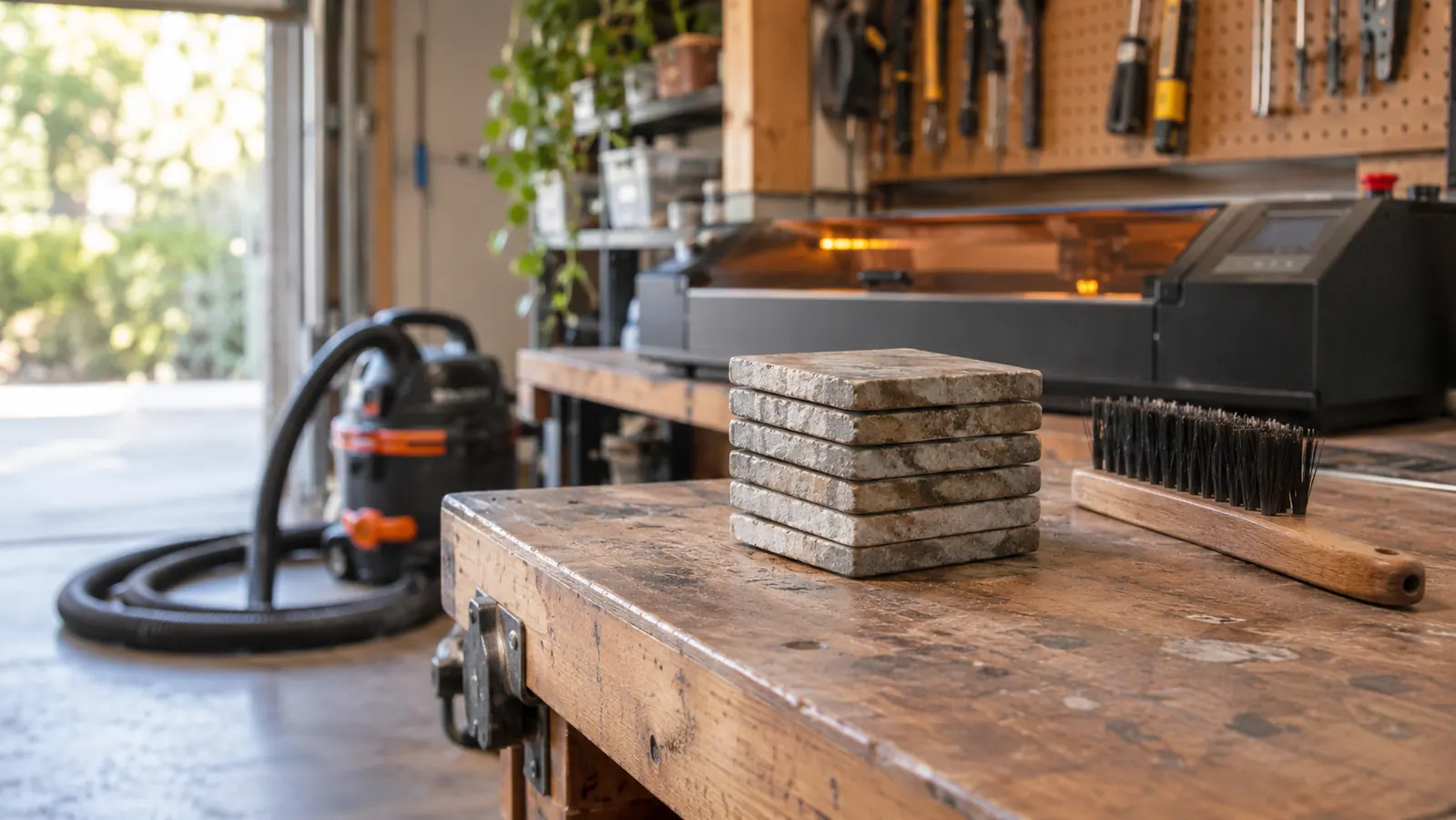
The first thing I do with a new batch of blanks is wreck one on purpose. Not carelessness. Self-defense. I want to know how the material behaves before a paying order is sitting on the bench, and with the MONKEY SUN 60 pack of 4 x 4 inch slate coasters I wrecked three before I trusted the batch. Two behaved. One did not. That is the honest summary of these coasters in a single sentence: good, workable blanks carrying a natural material's habit of never being quite identical to the piece sitting next to it. If you can live with that, you will get along fine with them. If you need sixty pieces that all engrave the same way at the same setting, no slate on the market will make you happy, and these are not the exception.
I run a small engraving setup out of the one-car garage behind my house, three years in now, and slate has turned into the item I sell most at church bazaars and to neighbors who want a small gift with a name on it. Cutting boards take longer and eat more material. Tumblers are fussy about the curve. Coasters are flat, forgiving to practice on, and people actually use them instead of putting them in a drawer. What follows is what four months and about nine boxes of MONKEY SUN stock taught me. The parts I like, the parts that irritate me, the things I would tell a friend before he bought a box, and the person who should probably walk right past them.
The Quick Verdict
Workable natural slate with honest variation between pieces. Buy it for volume and practice, not for identical results.
Amazon Check Today's Price →Sixty blanks is sixty chances to get your settings right before a paid order is on the bench
That is the real value of a bulk pack for somebody still learning the material. You burn a few, you learn the power and speed your machine wants, and the rest of the box goes out the door looking like you knew what you were doing.
Amazon Check Today's Price on Amazon →What Actually Shows Up in the Box
Sixty square coasters, four inches by four inches, natural stone with the rough handmade edge the listing describes. That is the entire contents list. No holders, no extras tucked in the bottom, nothing to unwrap. The pieces are cut to a standard footprint, and every one of mine sat inside the same L-shaped plywood fence I use as a jig on the laser bed with just a hair of play. Where they differ is thickness, and it differs enough that you can feel it when you stack a handful and run your thumb down the side. That is the one variable you have to plan around, and everything else about the box is what it says it is.
The box is heavier than most people expect. Sixty pieces of stone is a real chunk of weight, and it wants a spot on the floor or the bottom shelf of a sturdy rack rather than up high next to your leather scraps. I keep mine in the original box with a folded towel between layers, mostly so the rough edges do not grind against each other in storage. The rough edge itself varies piece to piece because the pieces are finished by hand. Some edges are gnarly and some are nearly smooth. None of mine were sharp enough to cut skin, but every single one of them shed a little grit on the bench.
Two pieces out of my last box had a nick on the corner. Not broken, just a chip taken off before it ever reached me. I set those aside for myself and engraved them anyway, because a chipped corner on a coaster headed for my own coffee table is not a crisis. That is the honest picture of a bulk natural stone pack. You will get a few pieces that look like they were handled somewhere along the way, and you will get a lot of pieces that look good enough to sell at a table. Count on the first box having a couple of shop pieces in it and you will not be disappointed when it does.
How I Have Been Running Them
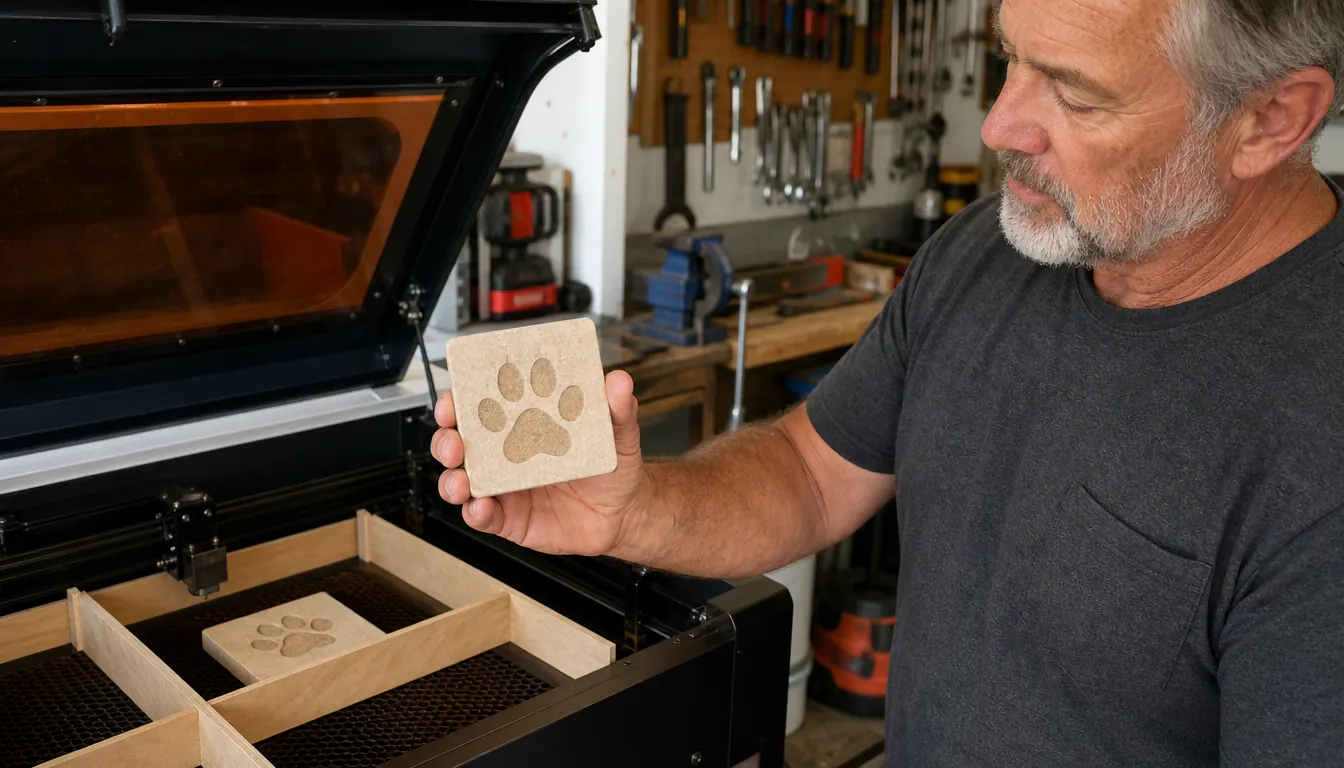
Every new box starts the same way. I pull the ugliest three pieces out of the stack and run a test grid on them, a row of small squares at increasing power and decreasing speed, so I can see where the stone takes a clean matte mark and where it just scorches and washes out. Slate is more forgiving than wood in some ways and less in others. It has no grain fighting you, but it does have a face that varies, and a setting that looks right on one piece can come out flat on the next. The grid takes me about twenty minutes and saves me a dozen ruined blanks later in the week.
Once the grid is settled, I set the jig and run them in batches of twelve. The L-shaped fence sits against two edges of the coaster so I only have to line up the design once, and I check focus on the first piece of each batch because of the thickness variation. My designs are simple by choice: a monogram, a small line drawing of a barn or a pine, a last name in a clean serif. Fine detail on slate is wasted effort. The stone swallows thin lines and rewards bold shapes with plenty of breathing room around them. If a design looks busy on my screen, it will look like a smudge on the coaster.
The batch that sells best for me is a set of four with a last name across the top and a small pine tree under it. Simple, fast to run, and it stacks flat in a tote for the church bazaar. I have also done a run of twenty for a neighbor's daughter's wedding, all the same monogram, and that order taught me why sorting by thickness matters. Twenty pieces in a row with the same design makes any inconsistency obvious, and I had to re-run four of them the first night. The coasters were fine. My approach was not.
After engraving, I brush the dust off with a soft bench brush and wipe the face with a barely damp rag. That is the entire finishing routine. The listing says hand wash only and that is correct, because a dishwasher is going to be rough on a rough-edged stone coaster and I would not warranty one through a cycle. I put a small card in with each set telling the buyer to wipe it down by hand. Half of them will ignore it. The other half will appreciate being told, and those are the ones who come back the next season for a second set.
What Nobody Tells You About Engraving Slate
The first thing nobody tells you is that contrast is not guaranteed. On a good day you get a crisp mark that sits clean against the face of the stone and looks like a print. On a bad day the same setting gives you a mark that reads more like a shadow, and you cannot tell which you are going to get until the piece comes off the bed. That is not a flaw in a particular box of coasters, it is the nature of the material, and the only defense is consistency. Same design, same setting, and a check on the first piece of every batch. When a piece comes out soft, I run a second pass on the same design before I decide it is a reject.
The second thing is dust. Slate engraves into a fine powder that gets on everything, and a shop vac hose held near the head helps but does not solve it. I vent through the window behind the bench, I wear a respirator when I am running a long batch, and I wipe the bed down after every session because the dust works its way into the rails. Anyone who tells you stone engraving is a clean process has not swept their garage lately. This is a material that makes you think about air and cleanup before you think about design, and that is true of any brand of slate, not just this one.
The third thing is chipping. Slate splits along layers, and the rough edge is where it likes to let go. I have had a corner lift off while I was handling a finished piece, not while it was sitting on the bed. The fresh chip catches the light differently than the face does and it is the first thing a buyer notices. Now I handle finished pieces over the bench with a towel under them, and I keep a small bottle of clear-drying adhesive on the shelf for the rare corner that lets go before it sells. It happens maybe once in a box, and it is always on the piece I had planned to photograph.
Fourth: it is stone, and stone breaks. A coaster dropped on a concrete garage floor is finished. That is not a knock on the MONKEY SUN stock, it is true of every slate coaster I have handled from any source. Pack them for a craft fair in a box with padding between layers, not loose in a tote, and expect to lose one now and then to a fumble. I plan for that the same way I plan for a misprint on a cutting board. It is part of the material cost of working with stone, and pretending otherwise just means you are surprised on a Saturday morning.
Nine of the sixty in one box ran a hair thicker than the rest. Those nine became my test pieces. That is not a defect, that is stone.
The Parts That Genuinely Bug Me
The grit is my least favorite thing about them. Handling thirty rough-edged coasters leaves your hands feeling like you have been playing in a sandbox, and the bench needs a wipe before you set down anything else. I keep a bench brush within reach and I brush each piece over the trash can before it goes into the finished stack. It is a small extra step multiplied by sixty, and it is the difference between a neat table at the bazaar and one that leaves a dust ring on the tablecloth where your display box sat. There is no getting around it with natural stone.
Thickness variation is the second annoyance, and it is the one that costs me time. Focus has to be checked more often than it would with a uniform manufactured blank, and the thin pieces need a shim or a re-focus or they come out soft. I have started sorting each box into three rough piles by feel, thin, middle and thick, and running them as separate batches. That sorting takes ten minutes and probably saves me three ruined pieces per box. It is not a defect in the product. It is the hourly cost of working with a natural material, and you either build it into your routine or you fight it all afternoon.
Third, sixty is a lot. For someone just starting out, sixty coasters is more inventory than they have orders for and more storage than they have shelf for. I went through my first box in about six weeks because I was doing a bazaar and a batch of neighbor orders at the same time, but a hobbyist doing one or two pieces a week will be tripping over that MONKEY SUN box for a year. That is not a reason to avoid the product. It is a reason to be honest with yourself about how fast you will actually use them before you clear a shelf for a year's worth of stone.

What Works and What Does Not
What I Liked
- Consistent 4 x 4 inch footprint that drops into a simple homemade jig with almost no play
- Natural stone with a handmade rough edge that reads as a real material, not a molded blank
- Sixty pieces is enough for several craft fair runs plus the practice pieces it takes to learn slate
- Engraves cleanly with strong contrast once the power and speed are dialed in for the batch
- Simple surface that needs no sanding or prep before it goes on the bed
Where It Falls Short
- Thickness varies piece to piece, so focus needs checking far more often than with a uniform blank
- The rough edges shed grit on the bench, in the box and on your hands
- A couple of pieces in a box arrive with a nicked corner
- Hand wash only, which means a conversation with every buyer
- Sixty stone pieces take up real shelf or floor space in a small shop
Who This Is For
If you already have a laser running and you want a flat, forgiving blank you can sell at a small price point, this is a sensible box to buy. It suits someone doing volume: a table at a bazaar, a run of twenty matching coasters for a wedding, a stack of gift sets at the holidays. It suits a beginner who wants to learn the material without feeling like every test piece is money in the trash, because there are enough in the box to burn a few and still have inventory. And it suits anyone whose customers like the look of real stone with a rough edge, which is most of the people who stop at my table and pick one up.
Who Should Skip It
Skip it if you want sixty identical pieces. Skip it if you are selling into a venue that expects a machined, uniform product with straight edges and a perfectly flat face every time. Skip it if you do not want to deal with dust, or if your machine sits in a room you cannot vent. Skip it if you are buying for one small project, because sixty pieces will outlast your interest in that project by about eleven months. And skip it if you are not willing to sort by thickness and check focus on the first piece of every batch. There are more uniform blanks on the market. They just do not look like stone.
Buy the size of box that matches the amount of practice you actually plan to do
If you are running a table this season, sixty is not too many. If you are still learning your settings, buy it anyway and treat the first ten pieces as tuition. That is what I did, and I still have the ten coasters on my own coffee table to prove it.
Amazon Check Today's Price on Amazon →