
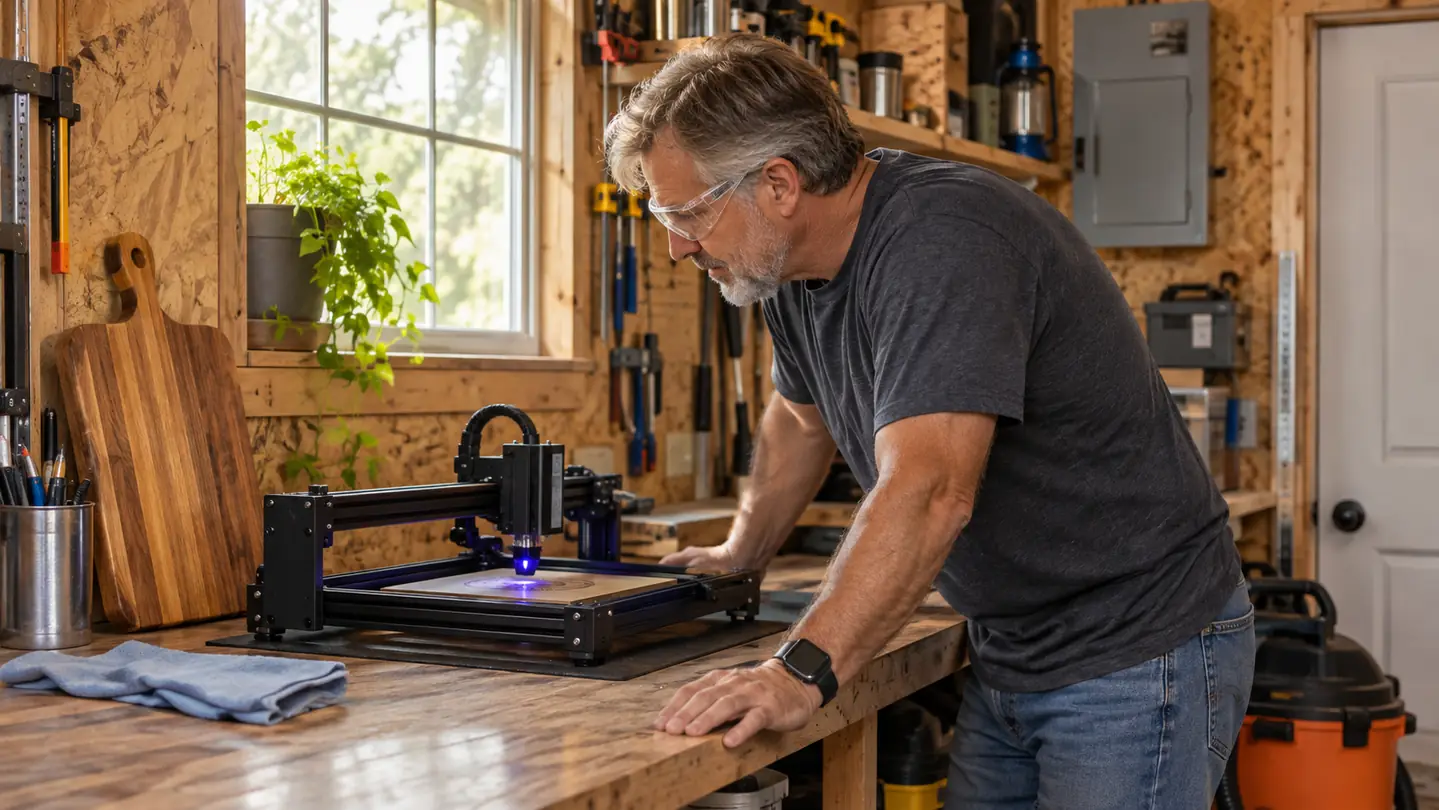
The laser glasses are the last thing anybody buys and the first thing they stop wearing. I know because I did it. For my first month of engraving I ran the diode laser in the garage wearing a pair of ordinary shop safety glasses, telling myself it was fine because the beam pointed down at the workpiece. That is not a reason. That is a hope. I ordered the FreeMascot Laser Safety Glasses after a neighbor who does stained glass asked me what I was protecting my eyes with and I did not have an answer.
This is not going to be a love letter. There are three things about this pair that still bother me enough that I notice them, and I am going to lay them out plainly, because that is the whole reason to read a review like this instead of the bullet points on the listing. But I will tell you where I landed: for the diode work I do, at the bench I do it on, these have earned their spot on the pegboard by the garage door, and I quit shopping for anything else about two years ago.
The Quick Verdict
A well-rated diode-band lens that is light enough to actually keep on your face, held back by a dark view, a standard fit, and anti-fog that quits after an hour in a cold shop.
Amazon Check Today's Price →Your eyes only get one pass through this
The FreeMascot pair is rated OD 4+ from 190nm to 550nm, which covers the 405nm and 450nm diode lasers most garage engraving setups run. Check the current price and match the spec sheet against your own machine before you buy.
Amazon Check Today's Price on Amazon →What Nobody Tells You About Laser Glasses
Buying a laser is exciting. The eye protection gets about five minutes of thought in a forum thread, half the replies say the cheap ones are fine, and then a fellow goes out and engraves slate coasters with his face a foot and a half from the work. I have been that fellow. The glasses are the least interesting purchase in the whole hobby and the one that matters most, and they are also the one item where a wrong choice looks exactly like a right one right up until it does not.
The number that matters is not the tint and it is not what you paid. It is the wavelength band the lens is rated to absorb, and the optical density it absorbs them at. OD 4+ means the lens knocks that band down by a factor of ten thousand. The FreeMascot pair lists 190nm to 550nm, a band that starts down in the ultraviolet and runs up through green. If your laser fires inside that window, the lens is doing its job. If it fires outside it, you are wearing dark plastic and feeling safe for no reason at all.
The second thing nobody tells you is that a pair you will not wear is worse than no pair, because it gives you a false sense of having handled the problem. Compliance beats specifications every time. I have a drawer of things I bought for safety and stopped using because they were uncomfortable, and every one of them was money thrown at a feeling. So when you read the complaints further down, read them in that light. Some are real, and none of them stopped me from putting these on.
How I've Worn Them
My shop is a one-car detached garage behind the house. The workbench runs along the back wall, there is a window I vent through, and the shop vac lives under the bench. It is not a clean room. In February the garage is cold enough that you can see your breath for the first hour, and in July it is a sweatbox. That matters for a review of anything you wear on your face, because a lens that behaves in a climate-controlled shop may fog badly in mine.
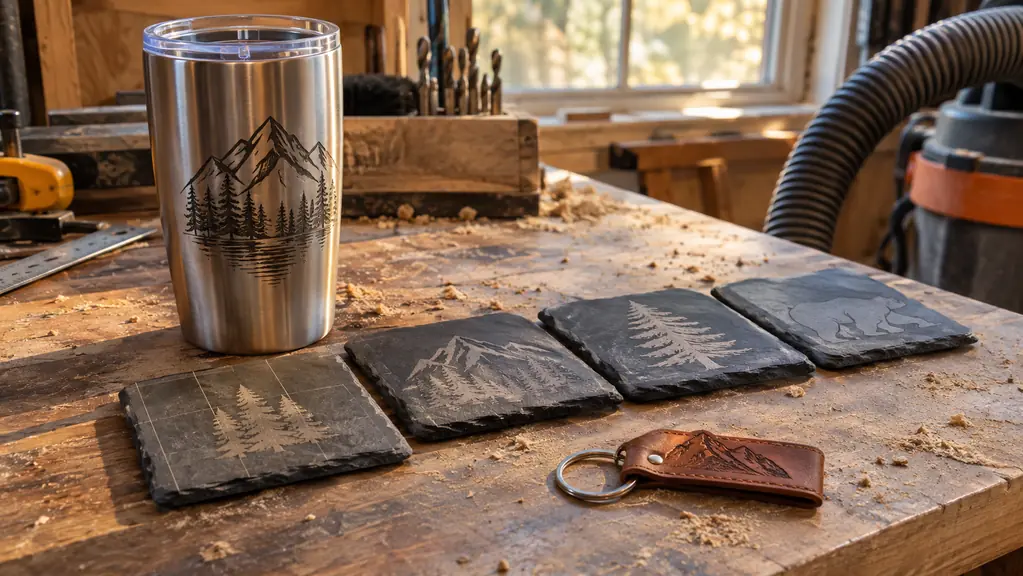
Most of my work is maple and walnut cutting boards, stainless tumblers, slate coasters, leather keychains and small wooden signs for craft fairs and church bazaars. My wife Carol helps pick the designs and runs the table with me. A typical Saturday is two to four hours at the machine with breaks to swap blanks and brush off char. I am not running production shifts. I am a retired HVAC man with a hobby that pays for its own materials, and the glasses get worn in short stretches with a lot of leaning in and squinting at the work.
That last part is where the honest review lives. Two to four hours is not a long time to wear a pair of glasses. It is long enough to notice weight on the bridge of your nose, long enough to notice fog, and long enough to notice whether the view through the lens is good enough to line up a design on a dark blank.
Where They Actually Earn Their Keep
The optical density is the main thing and I will not pretend otherwise. OD 4+ across 190nm to 550nm covers the wavelengths named on the listing, the 405nm, 445nm, 450nm, 520nm and 532nm emitters, and those are exactly the diode lasers people buy for a first engraver. If you are running a 450nm module in a desktop machine, you are inside the band with room to spare. That is the whole justification for the purchase, and it is a good one.
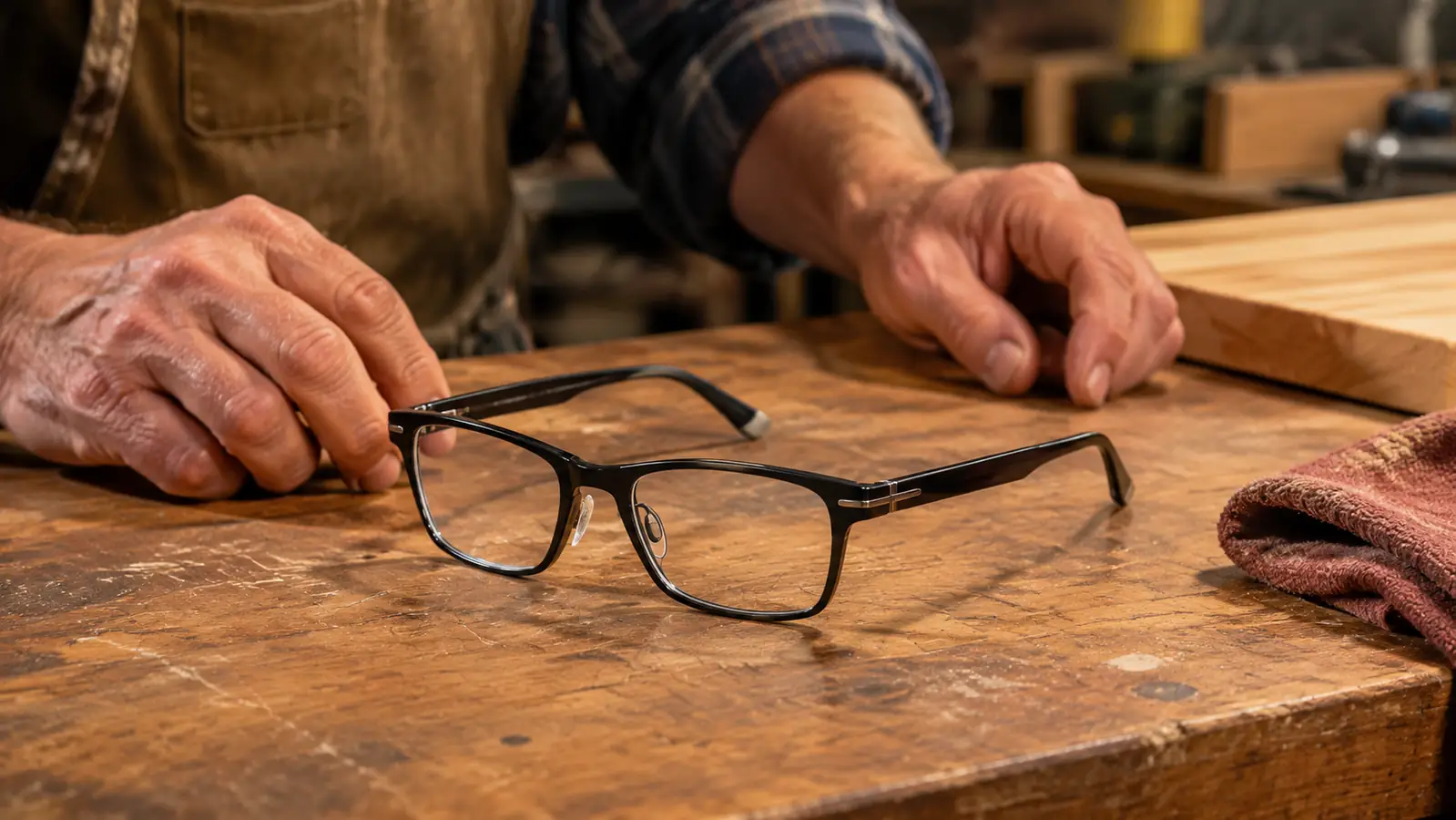
The second thing is weight. The pair weighs 3.53 ounces, and the frame is full rim plastic with polycarbonate lenses. I want to be clear that 3.53 ounces is not nothing on the bridge of your nose, but it is light enough that I forget I have them on during a two-hour session. I have worn heavier safety glasses that I was constantly pushing back up. These stay put well enough that I stopped thinking about them, which is the highest compliment you can pay a piece of safety gear.
Third is the anti-fog coating. It works. In a cold garage it works for maybe an hour before the coating gives up and I am wiping the lenses on my shirt. That is better than the nothing I get from uncoated glasses, and it is not the same as fog-free, so set your expectations there. The frame is full rim, which means a solid edge runs all the way around the lens with plastic surrounding it rather than a thin wire digging into your cheek, and that matters more the longer you stand at the bench.
Fourth, and this is small but I noticed it: the fit is standard and the frame is compact at roughly 5 by 5.9 inches, so it sits close to my face. A close fit is good for stray reflections off a shiny blank. It is bad if you wear progressives, which I do, because these are built to sit on your face and not over another pair. I take my reading glasses off, put these on, line up the design, take these off, put the reading glasses back on. If I did that twenty times a day I would have bought something else by now.
The Wavelength Question, Which Is Where People Get This Wrong
I want to spend a minute here because it is the most common mistake I see in the engraving groups, and it is a mistake that makes a purchase useless without ever making it feel useless. These glasses cover 190nm to 550nm. That is the diode window. It covers the blue and violet modules most people start with, and it covers green. What it does not cover is anything up around 1,064 nanometers, which is where fiber lasers live, or out at 10,600 nanometers, which is where a CO2 laser lives. If you have moved up to either of those machines, this is not your pair, and no amount of careful wearing will fix that.
I will say the same thing in the other direction. If you are just starting out with a diode module and somebody in a forum tells you to buy the expensive multi-band pair that covers everything, you can ignore that for now. Buy what matches your machine. The FreeMascot pair matches a diode machine, which is what most of us in a garage are actually running, and it does that job at a rating that leaves margin without charging you for coverage you will never use.
What Actually Bugs Me
Now the complaints, in the order they annoy me. First, the view is dark. Visible light transmission is listed at 30 percent, and 30 percent is a real cut. On a bright maple board with a pencil layout line I can see well enough to work. On a dark walnut blank with a fine line I am leaning in and squinting, and I have more than once pushed the glasses up onto my forehead to check something before catching myself. That is a bad habit created by a dark lens, and it is the strongest argument I can make against this pair.
Second, the anti-fog coating is temporary in a cold shop. An hour in, give or take, and I am breathing through my mouth and wiping. In July it is not an issue at all. In February it is a small irritation two or three times a session. A tighter seal on the face would fog worse rather than better, so I am not sure there is a fix available here, but I am telling you so you are not surprised by it.
Third is the reading glasses swap I already mentioned. It is a nuisance rather than a hazard, but it is the reason a friend of mine passed on these and bought a pair built to go over his prescription frames. If that is your situation, be honest with yourself about it up front, because the swap gets old fast and old habits are how a man ends up engraving with nothing on his face at all.
Fourth, and this one is minor: these are a lens you want to keep off scratches, because a scratched anti-fog coating is a scratched coating, and a scratched coating does not protect the way it did on day one. Mine live in a soft pouch in the bench drawer along with a microfiber cloth, and I wipe them before every session whether they look like they need it or not.
What I Liked
- OD 4+ rating across 190nm to 550nm covers the 405nm and 450nm diode lasers most garage engravers run
- 3.53 ounces with a full rim plastic frame, light enough to forget during a two-hour session
- Anti-fog coating genuinely helps in a cold garage for the first hour or so
- Standard fit sits close to the face, which cuts stray reflections off shiny blanks
- A rating that matches a first diode machine without charging for bands you will not use
Where It Falls Short
- 30 percent visible light transmission makes fine layout lines on dark wood hard to see
- Not built to wear over prescription glasses, so you will be swapping back and forth
- Anti-fog coating fades after about an hour in an unheated shop
- Covers the diode band only, so it is the wrong pair once you move to fiber or CO2
OD 4+ across 190nm to 550nm is the whole point. It covers the 405nm and 450nm diode lasers most of us are actually running in a garage, and it does not pretend to cover the machines we are not.
Who This Is For
This pair makes sense for the person running a diode laser in a garage, a spare room or a shed, doing a few hours a week on wood, slate, leather or coated metal. It makes sense if you are just starting out and you want a rating that matches your machine without paying for wavelength coverage you will not use. It makes sense if you wear your safety glasses rather than leaving them on a shelf, because the light weight and the close fit mean you will actually keep them on. If that is you, the FreeMascot pair is a straightforward yes and you can stop reading reviews.
It also suits the person who does a lot of leaning in. The close standard fit and the full rim frame mean you are not looking under the bottom edge of the lens when you tilt your head to check an edge, and looking under the lens is most of what goes wrong with cheap shop glasses in my experience.
Who Should Skip It
Skip it if you wear prescription glasses and want something to pull on over them. The fit is standard and these are meant to sit on your face directly, not on top of another frame. Skip it if your machine is a CO2 or a fiber laser, because the band stops at 550nm and those machines fire well outside it. Skip it if you are running long production sessions where the 30 percent transmission will wear you down, or if you work under lighting you cannot turn up, because you will spend the afternoon squinting.
And skip it if you are the kind of person who buys safety gear and then leaves it on the bench because it is a little dark or a little foggy. That is not a knock on the glasses. It is a knock on the habit a lot of us have, and if you know you will not wear them, buy the pair you will wear, whatever that turns out to be. The best protection is the one on your face when the machine fires.
Match the lens to the laser, then get back to work
OD 4+ from 190nm to 550nm, 3.53 ounces, full rim frame, anti-fog coating, standard fit. If you are running a diode module in the garage, this is the pair that covers it. Check today's price on Amazon and read the spec sheet against your own machine before you commit.
Amazon See the FreeMascot Laser Safety Glasses on Amazon →