
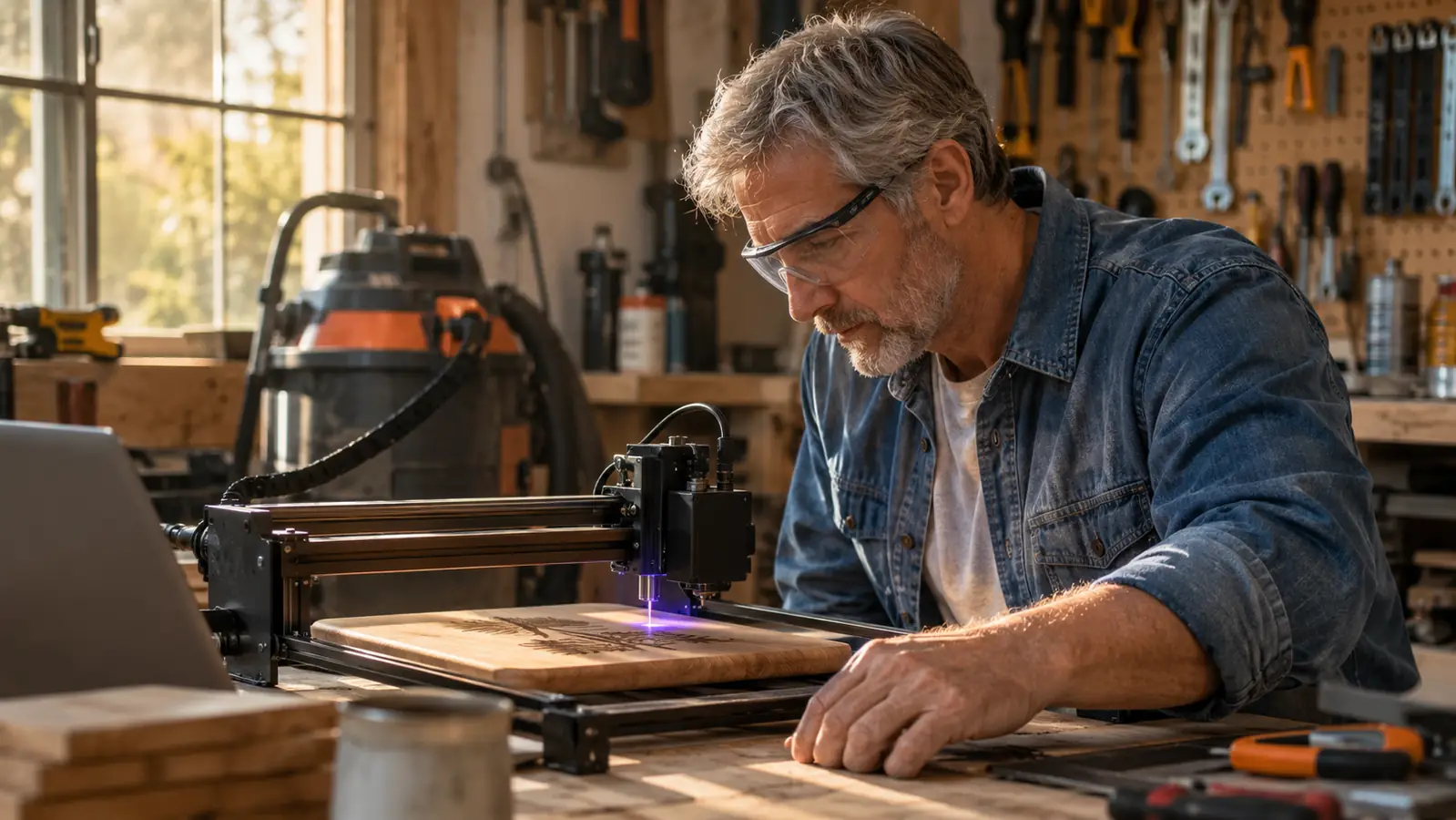
I run a weekend engraving setup out of the one-car garage behind my house outside Harrisburg. Maple cutting boards, stainless tumblers, slate coasters, leather keychains, small signs. Carol helps pick designs and works the craft fair table with me. Three years in, the one piece of gear I wish I had bought sooner is a proper pair of laser safety glasses. The FreeMascot Laser Safety Glasses are what I keep on the bench now. They are not fancy. They are the thing I reach for before the lid closes.
Beginners tend to spend on the machine and skip the eyewear. I did. I wore whatever tinted glasses were in the drawer and told myself the enclosure was enough. Then I started cutting more often, longer sessions, and the glare off a stainless tumbler made me think twice. What I tried first was a pair of amber shooting glasses that lived in the truck console. They looked the part and told me nothing about what they blocked, which is the whole problem with borrowed eyewear. This list is the practical case for buying a rated pair. No scare stories. Just the reasons the FreeMascot pair earned its spot in a small shop like mine.
Put a Rated Pair on the Bench Before Your Next Order
The FreeMascot glasses list OD 4+ from 190nm to 550nm and 30 percent visible light transmission. Check your machine against that range, then keep them within reach of the lid.
Amazon Check Today's Price on Amazon →They cover the wavelengths my diode machine actually uses
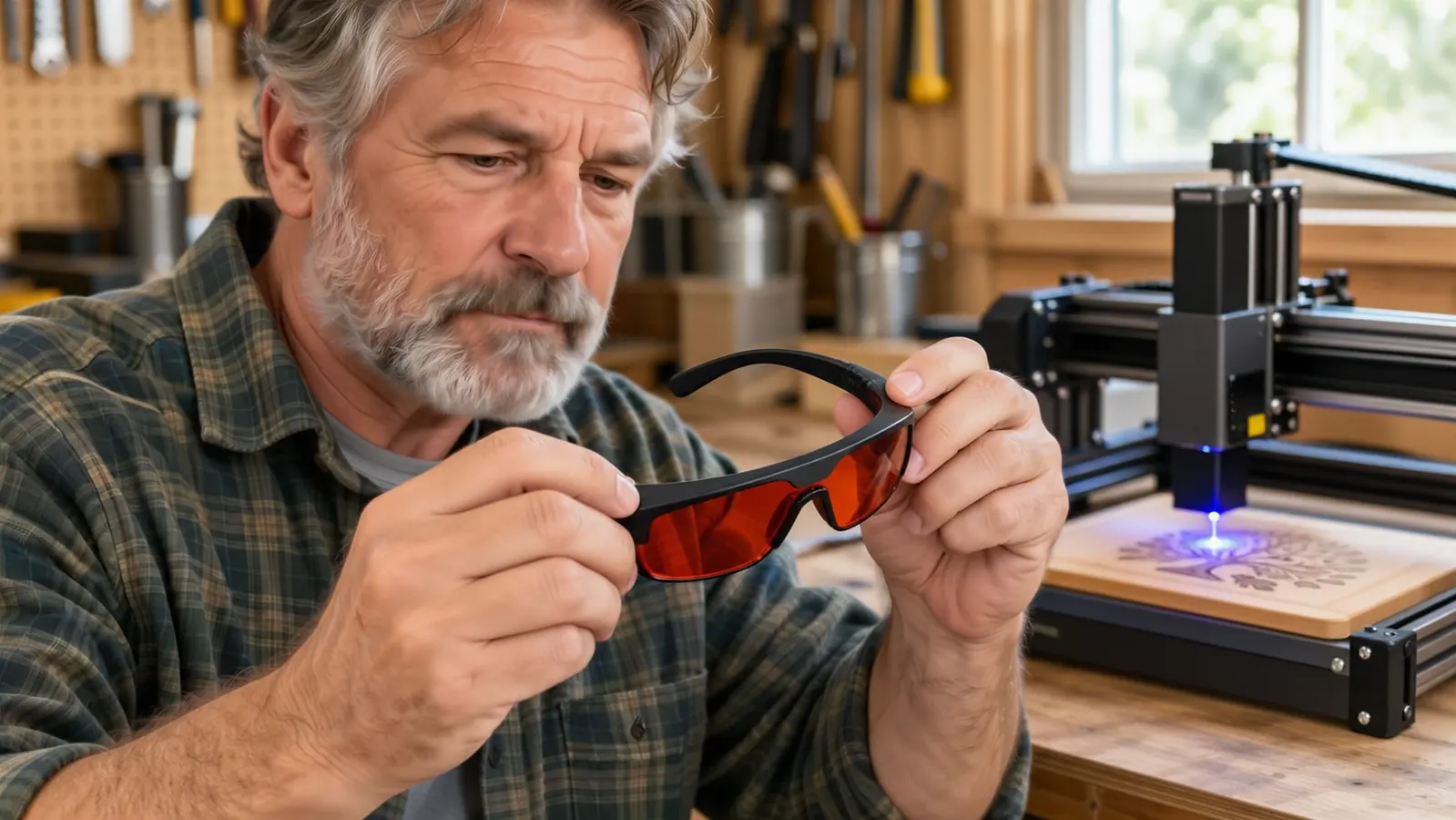
The listing rates these FreeMascot glasses at OD 4+ from 190nm to 550nm, with typical coverage called out for 405nm, 445nm, 450nm, 520nm and 532nm. My engraver runs in that family. That matters more than a dark tint. A pair can look protective and still be rated for a different wavelength. I checked my machine against the label before I trusted them, and I keep that habit.
They put a real number on the lens, not just a dark tint
FreeMascot lists visible light transmission at 30 percent. That number tells me how much visible light gets through instead of leaving me to guess from the shade of the lens. I want a spec sheet I can compare with my machine, not a pair that feels right on my face. Thirty percent is enough to see the workpiece and the edge of the cut without pulling the glasses off every few minutes.
The anti-fog coating earns its keep in an unheated garage
My garage goes from cool morning to warm afternoon, and a laser running on a cutting board adds its own heat. Last November I had a run of twelve slate coasters due for a church bazaar table, and the garage was cold enough that my breath showed. Plain glasses fog when I lean over the work, and I was leaning over the work every few minutes that week. The FreeMascot pair has an anti-fog coating, and that is the difference between leaving them on and pushing them up on my head. I still wipe them now and then, but I am not fighting them all session.
The full rim and flexible frame stay put when I lean in
I lean close to watch the beam on a slate coaster, and I do not want a frame sliding down my nose. These have a full rim and a flexible plastic frame. The fit is listed as standard. That combination suits a garage bench better than a loose pair of shop glasses that shifts every time I turn my head. I set them once and get back to the order.
They are light enough that I forget I have them on
The listing puts them at 3.53 ounces, or 0.1 kg. That is light enough that I am not aware of them during a two-hour session of coasters and keychains. Saturday mornings I am usually at the bench from about eight until Carol calls me in for lunch, and that is a long stretch to have something pinching behind my ears. Heavy eyewear gets taken off. Light eyewear stays on. It is a simple thing, but it is the difference between owning safety glasses and wearing them.

The UV protection is one less question in my head
The listing says ultraviolet light protection is yes. I am not a lens engineer, and I do not pretend to be one. I just know I would rather have that box checked than wonder about it while I am working through a stack of maple boards. It is part of why the FreeMascot pair stays on the hook by the bench instead of in a drawer.
They fit a normal workday, not just a quick demo
The listed dimensions are 6.2 by 5.6 by 2.2 inches, with a size of 5 by 5.9 inches and a standard fit. That is a normal pair of safety glasses, not a piece of gear that only works for a five-minute demonstration. I wear them through cutting board runs, tumbler batches and a pile of leather keychains. They are built for indoor use, which is where my engraver sits.
They make the safety talk shorter when someone visits the shop
A neighbor stops by to pick up a sign, or Carol brings someone back to see the craft fair setup. I do not want to give a speech. I hand over a rated pair and point at the machine. The FreeMascot glasses have the wavelength range and the OD rating printed where I can show them. That makes the conversation short and the visit safer.
They handle being treated like shop gear
My glasses live on a hook above the bench, not in a velvet case. The frame is plastic and the lenses are polycarbonate, so they suit that kind of handling. The first week I owned them I set them down on the edge of the bench while I swapped a board, and they went off onto the concrete lens first. I picked them up expecting a crack and found nothing. I have knocked them down more than once since and they are still in service. I would not step on them on purpose, but I do not have to baby them between orders.
They pay off in fewer do-overs, not in a pitch
The real payoff is not a number on a listing. It is the coaster batch I do not have to rerun because I was squinting and misread the depth. It is the tumbler I do not ruin because I took the glasses off to get a better look. A rated pair keeps me at the bench and keeps the work moving. That is what I want from gear in a small shop.
What I'd Skip
I would skip the tinted sunglasses by the engraver. I would skip any pair that does not list a wavelength range and an OD rating. I would skip taking the glasses off for a closer look, because that is exactly when the beam is doing its work. I would also skip the idea that an enclosure replaces eyewear. The enclosure helps, and I still keep the FreeMascot pair on the hook. Buy one rated pair, check it against your machine, and leave it by the lid.
The label says OD 4+ from 190nm to 550nm and 30 percent visible light transmission. That is the kind of detail I can check against my machine.
Keep the Pair Where You Can Reach It
If you run a diode engraver in a garage, the FreeMascot glasses cover the common wavelengths and list a 30 percent visible light transmission. Put them on the hook by the lid and use them on every order.
Amazon Check Today's Price on Amazon →