

I bought my first pair of laser safety glasses the same week I brought the machine home, and I wore them exactly twice. They fogged up within a minute, they pinched behind my ears, and I was never quite sure the tint was matched to the wavelength my laser actually puts out. They went into the top drawer of the workbench and stayed there for most of a year while I told myself I was being careful.
That is the trouble with eye protection in a one-car garage behind the house. Nobody checks. There is no supervisor, no sign on the door, nobody to catch you. Carol will stick her head in from the driveway and ask whether I have them on, I will say yes, and we will both let it stand at that. The only person auditing the habit is me, and I am not a reliable auditor. The FreeMascot OD 4+ laser safety glasses are the pair that finally stayed on my face through a full season of weekend work, and it was not because I got more disciplined. It was because they stopped handing me reasons to take them off.
The Quick Verdict
The pair that survived an unheated garage and a four hour Saturday without getting pushed up my nose. The tradeoff is a dim work area and a frame that loosens as the months add up.
Amazon Check Today's Price →The pair that stayed on my face for a whole Saturday
Rated OD 4+ across 190nm to 550nm, anti-fog coating, full rim frame, 3.53 ounces. If your last pair is still sitting in a drawer, start here.
Amazon Check Today's Price on Amazon →How I've Used It
I have been engraving out of that garage for about three years now. Most of what goes across the bed is maple and walnut cutting boards, stainless tumblers, slate coasters, leather keychains, and small wooden signs for the craft fair table. Carol picks most of the designs and runs the table with me at the church bazaar and the two local fairs we do in the fall. The rest is custom orders from neighbors who saw something on the table and want one with a name on it.
A normal Saturday is two to five hours at the bench. The machine sits inside a small enclosure and I vent out the window with the shop vac running. The enclosure has a viewing window, and the honest truth is that the window is the reason I got lazy about glasses in the first place. You can watch the beam through it and nothing seems to be happening to your eyes. That feeling is not evidence of anything.
The session that settled it was a Saturday in early March. I had twelve slate coasters to run for the church bazaar table, each one a two pass job, and I was at the bench from a little after eight until nearly one with one break for coffee. That is as long a stretch as I ever do. With the old pair I would have had them pushed up on my forehead four or five times by the second hour, and once they come off they tend to stay off. This pair stayed where I put them.
The FreeMascot pair sits on the bench next to the machine now, in the same spot every time. I put them on before I close the lid and take them off after I pull the piece out, and over the last several months that has turned into a habit without me having to force it. I have worn them over my regular reading glasses on the days I need to read fine detail on a slate coaster, and the full rim frame keeps the whole arrangement from sitting crooked on my face.
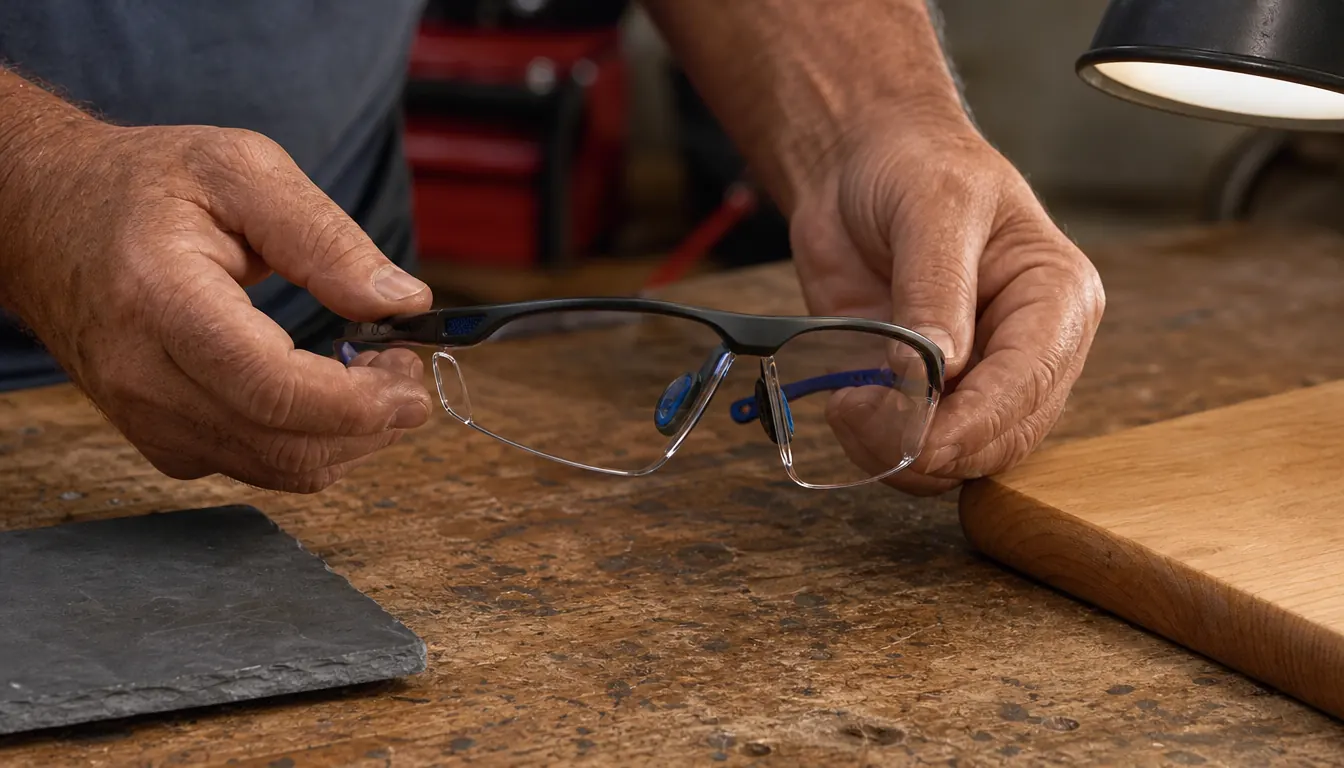
What OD 4+ Actually Means at the Bench
The number on the box is optical density, and the range beside it is the part that matters more. This pair is rated OD 4+ across 190nm to 550nm, which takes in the wavelengths the listing names: 405nm, 445nm, 450nm, 520nm and 532nm. My diode module runs at 450nm, so it lands squarely inside that window. That sounds like a small thing until you have owned a pair of generic safety glasses with no wavelength rating printed anywhere on them and no way to find out what they were actually made for.
Optical density is a measure of how much of a given wavelength gets through the filter. OD 4+ means the lenses are knocking that light down by a large factor rather than a small one. I am not going to pretend I can verify the number with anything in my garage. What I can tell you is that the glasses are marked, the marking is specific, and it matches the machine I own. That is more than the pair in the drawer could say for itself.
One thing worth being clear about, because it is the mistake I nearly made. These cover the visible and near ultraviolet range from 190nm up to 550nm. They are not for a CO2 machine, which cuts at a wavelength sitting far outside that band. If you are running a diode or a laser in the 405 to 532 range, you are in the right window. If you are not sure what your machine puts out, find that out before you buy any eyewear at all, because a filter rated for the wrong wavelength makes you feel protected when you are not, and that is a worse position than knowing you have nothing.
The Anti-Fog Coating and the Comfort Question
My garage is unheated, and in November the mornings are cold enough that you can see your breath. That is the condition that killed the last pair. Anti-fog coating is listed on this one, and it is also listed as a special feature alongside a flexible frame. I did not expect much from either claim. What I got was a lens that stayed clear through a two hour session on a cold morning, with the caveat that a long humid afternoon in July will still fog the bottom edge near my nose if I am breathing hard and leaning in close.
The fog test I actually ran was not deliberate. I had a batch of leather keychains to run on a morning when the garage thermometer read thirty-four degrees, and I had left the side door open while I hauled the shop vac around. Cold air, warm face, and that is the setup that fogs a lens. It crept in at the top edge of the right lens and cleared within a few seconds once I stopped moving. The old pair would have left me looking through a smear for the rest of the session.
Comfort is the part that decides whether a pair of glasses gets worn, and this is where the weight helps. The listing puts them at 3.53 ounces, with a plastic frame and polycarbonate lenses. That is light enough that I stop noticing them about ten minutes into a session. The frame is flexible, which I noticed most when I have them pushed up on my forehead between cuts and then pull them back down again.
Fit is listed as standard, with dimensions of 6.2 by 5.6 by 2.2 inches and a size noted as 5 by 5.9 inches. I have a fairly average head and they sit well on me, snug without pressing. If you are at the wide end, the flexible frame will buy you some room but it is not an adjustable frame, so there is a limit to how far that goes. That is the one thing I would flag for anybody ordering without trying a pair on first.
Where They Get in the Way
Visible light transmission is listed at 30 percent, and that is the tradeoff you are making. These are dark glasses to look through. The first afternoon I wore them I kept leaning closer to the work than I needed to, because the bench just looked dimmer than I was used to. I ended up adding a second task light over the machine, angled from the side, and that solved it. If you are the sort of person who will not add a light and will instead push the glasses up to see, this pair will not fix that for you.
I tried to fix the dimness twice before I got it right. The first attempt was a clamp lamp aimed straight down at the bed, which was no use because it threw a shadow from my own hands right where I was trying to watch. The second was moving the bench closer to the window, which only works until about four in the afternoon in winter. What finally worked was a small task light on a flexible arm, clamped to the enclosure and angled in from the left at about chest height. Between that and the overhead, the bench reads clearly through the lenses and I have not leaned in close since.
They are also listed for indoor use, which in practice means they live on the bench and do not travel. I am not carrying them out to the truck or into the yard. That is fine for my situation, but if you want one pair that covers everything you do outside the shop as well, this is not that pair and it is not pretending to be.
The last thing is the frame. It is flexible, which is good for comfort, and it also means the temples have loosened slightly over several months of regular wear. Nothing has broken and nothing has popped out, but they do not grip the way they did in week one. I expect to get another year or more out of them. I do not expect them to be the last pair I ever buy.

What I Compared Them To
Before this I ran two other things. The first was the unrated pair in the drawer, which I have already been unkind enough about. The second was a stretch of a few weeks where I wore ordinary dark sunglasses, which is a thing a lot of people in hobby groups will quietly admit to. Sunglasses are not a filter and they are not rated for anything. They cut the brightness, which makes the beam feel less blinding, and they do nothing about the specific wavelength coming off the module. The difference between sunglasses and a rated pair is not a matter of degree. It is the difference between a real filter and a dark window.
The other comparison is to the pair I did not buy, which was a heavier over the glasses goggle from a welding supply shelf. That one had a wider seal around the face but weighed noticeably more and fogged faster. For two hour sessions at a hobby bench, the lighter pair won, and I have made the longer case for that sunglasses comparison elsewhere on this site.
The heavier goggle had one more problem, which is that it sat so far off my face that I could not get my reading glasses under it at all. I do a fair amount of fine checking on slate, making sure a design has not drifted, and I need the readers for that. Any pair that forces me to choose between seeing the work and protecting my eyes ends up in the drawer. That decided it for me, more than the weight.
What I Liked
- Rated OD 4+ across 190nm to 550nm, which covers the 405, 445, 450, 520 and 532 wavelengths named on the listing
- Anti-fog coating held up through a cold morning session in an unheated garage
- 3.53 ounces, light enough that I stop noticing them mid-session
- Full rim frame with polycarbonate lenses and a flexible plastic frame that goes over reading glasses
- Marked and specific about what it filters, which is more than most budget pairs manage
Where It Falls Short
- 30 percent visible light transmission dims the bench, and I needed a second task light
- Listed for indoor use, so they stay in the shop
- Fogging is reduced rather than eliminated on a humid afternoon when you lean in close
- Standard fit with a flexible frame means wide heads will feel some pressure
- Temples loosened slightly over several months of regular use
The first afternoon I wore them for four hours straight, I never once pushed them up my nose. That had never happened with the pair in the drawer.
Who This Is For
This is for the hobby engraver running a diode module in the 405 to 532 range who wants one pair of rated glasses that will actually stay on. If you are doing two to five hour sessions at a bench in a garage or a spare room, the weight and the anti-fog coating are the two things that will matter most to you, and both of them hold up. If you wear readers while you work, the full rim frame and flexible temples handle that without much fuss.
It is also a sensible pick if you have been getting by on sunglasses or an unmarked pair and you want to stop guessing. The value in the FreeMascot pair is that the filter is stated plainly on the product, which means you can check it against your machine in about ten seconds instead of taking the whole thing on faith.
Who Should Skip It
Skip it if you run a CO2 laser or any machine outside the 190nm to 550nm band. The filter is not built for that and no amount of listing copy changes the physics. Skip it if you need one pair for yard work as well as bench work, since this one is listed for indoor use and the visible light transmission is low enough that you would not want to be walking around in it.
Skip it, too, if you know in your gut that you will not add a light and will not build the habit. Dark lenses plus a dim bench is exactly the combination that has people pushing their glasses up onto their forehead for one quick look, and one quick look is how most garage shop eye injuries happen. The glasses are good. They are not a substitute for deciding you are going to wear them.
If your last pair is still sitting in the workbench drawer
Rated OD 4+ from 190nm to 550nm, anti-fog coating, 3.53 ounces, full rim. Mine has lived on the bench next to the machine since spring.
Amazon Check Today's Price on Amazon →