

The question comes up at every craft fair I set up at, usually from somebody holding a pair of drugstore sunglasses and squinting at my engraver. Do I really need the laser glasses, or will any dark lens do? Short answer: no, any dark lens will not do, and the gap is not subtle once you understand what the lens is being asked to stop. The FreeMascot Laser Safety Glasses carry a real rating, OD 4+ from 190nm to 550nm, printed on the frame and meant to be checked. Cheap sunglasses are engineered to make a sunny afternoon less bright. Those are two different jobs, and one of them has nothing to do with laser light.
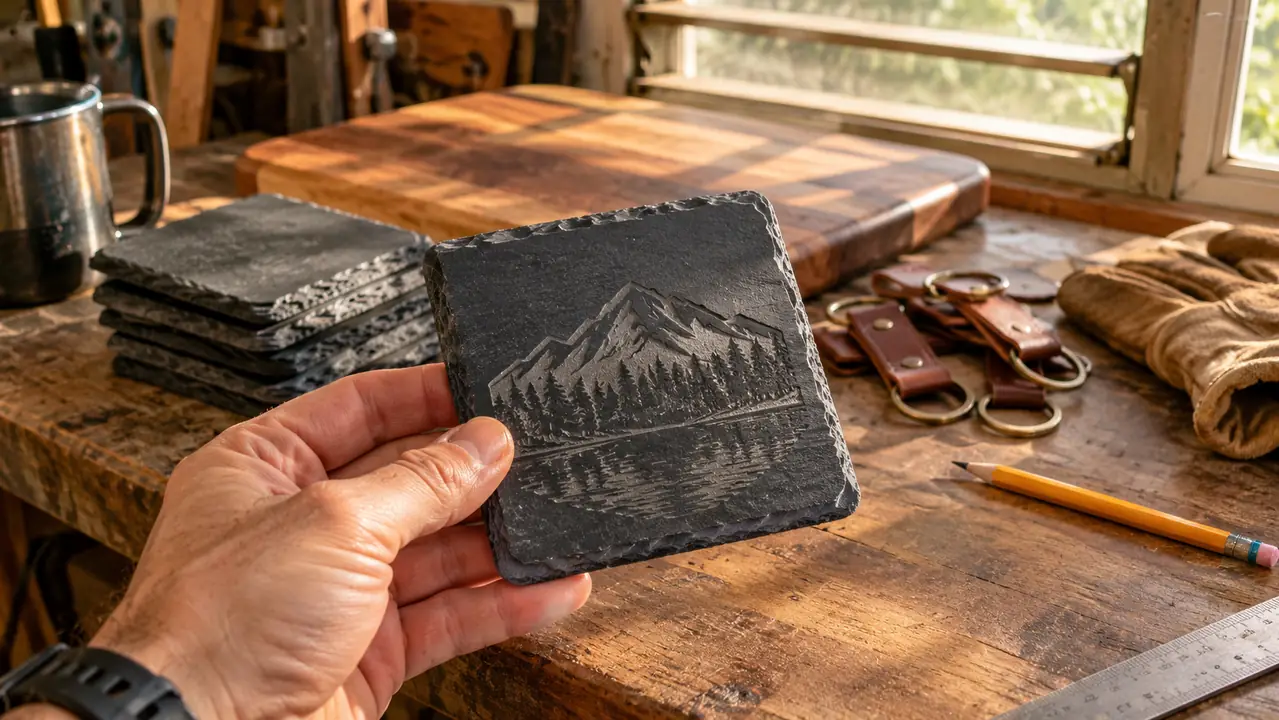
I run a small engraving setup in a one-car garage behind the house outside Harrisburg. Maple cutting boards, stainless tumblers, slate coasters, leather keychains, whatever the craft fair crowd asks for. About three years into it, on a Saturday morning in late February, I ran a batch of sixteen slate coasters for a church bazaar, a design my wife Carol had picked out of a pattern book. I had a pair of cheap sunglasses pushed up on my forehead, the way you do when you figure you will only be at the machine for a minute. Three hours later I finished the batch, pulled the glasses down off my head, and spent the rest of the day with a dull ache behind my right eye. Nothing dramatic happened. That is the point. The damage laser light does to a retina is quiet and it does not hurt while it happens. That is not a warning I read somewhere. That is a Saturday. I bought the FreeMascot pair the following week and I have not engraved a board without them since.
| FreeMascot Laser Safety Glasses | Drugstore Sunglasses | |
|---|---|---|
| Wavelength coverage | Rated OD 4+ from 190nm to 550nm, which spans 405, 445, 450, 520 and 532nm | No wavelength rating at all, just a tint |
| Optical density | OD 4+, printed on the frame and meant to be read | Nothing printed, nothing tested against a beam |
| What you can still see | 30% visible light transmission, so the grain and the dot both stay readable | Usually too dark, which is why people push them up and look underneath |
| Side coverage | Full rim frame, closed at the temple | Open at the sides, so reflections come in around the lens |
| A two hour session | Anti-fog coating and a flexible frame, 3.53 ounces | Fogs on the first warm breath, arms dig in before the second board |
| Cost to get started | A separate purchase, not something already in the drawer | The cheapest way to cover your eyes, and you may already own a pair |
| Getting it today | Ordered from a laser supplier and shipped | Any gas station, any checkout aisle, tonight |
| Sunlight | Listed for indoor work | Built for exactly this |
| Best for | Diode work in the 405 to 532nm range | Anything except laser work |
Read that table the way I read it. The FreeMascot pair takes most rows because it is doing a job sunglasses were never asked to do. But it does not take all of them, and the rows it loses are the reason there is still a folded pair of cheap sunglasses in my garage drawer.
Where FreeMascot Wins
Start with the rating, because everything else follows from it. OD 4+ means the lens knocks the light down by a factor of ten thousand at the wavelengths it is rated for. That number is on the frame because somebody tested it, and the range covers 190nm to 550nm, which is exactly where my diode modules live: 405, 445, 450, 520 and 532nm. A blue 450nm diode and a green 532nm module are two very different beams, and one pair of glasses is rated for both. Sunglasses do not have a wavelength range. They have a darkness. Those are not the same measurement, and treating them as one is how people get hurt.
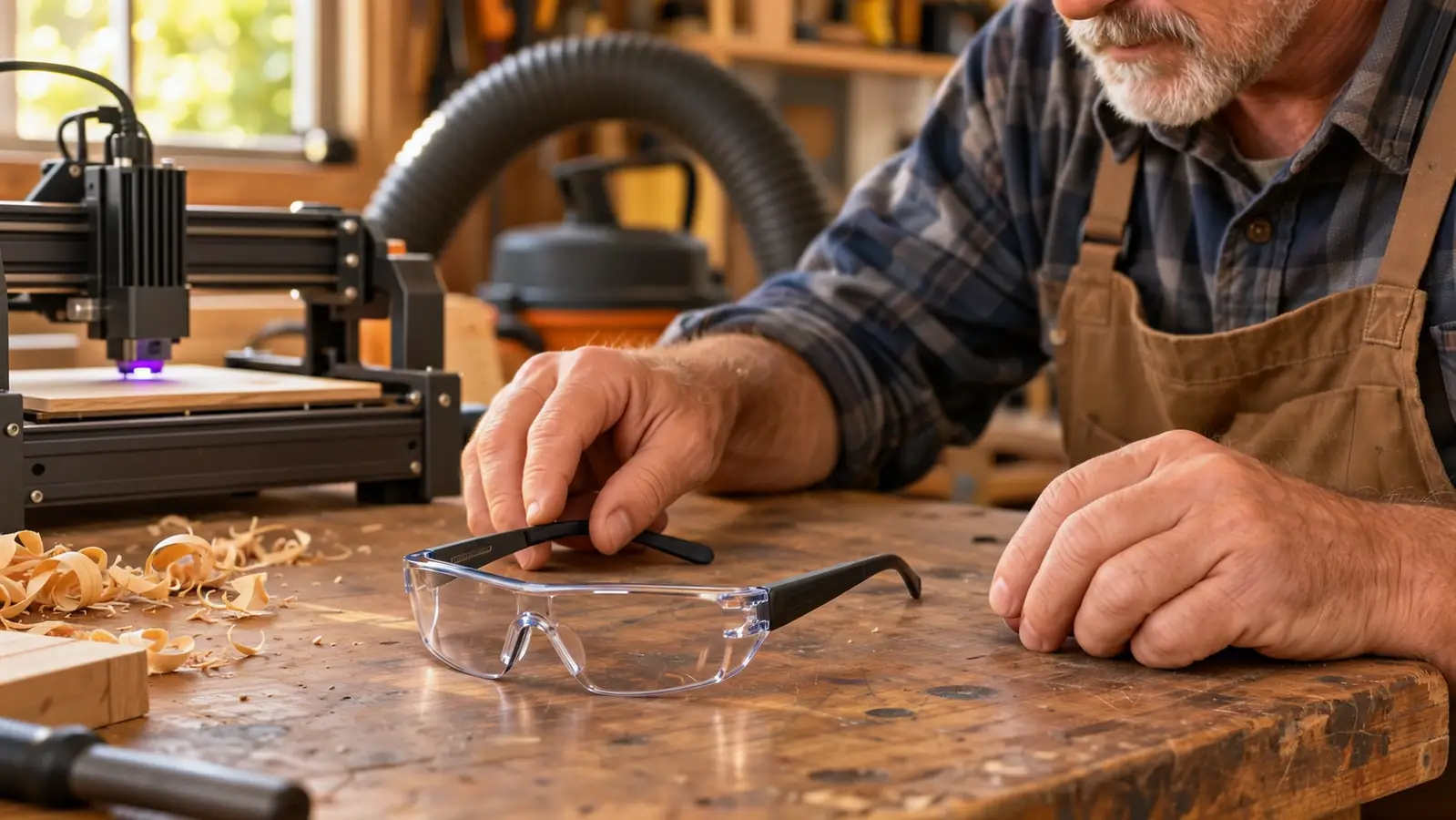
The second thing is what you can still see while wearing them. Visible light transmission is 30% on this pair, a number I did not appreciate until I worked a full session behind a lens that was too dark. When the lens is too dark you do one of two things. You push the glasses up and look under them, or you lean in closer to see the seam and put your face nearer the beam. Neither one is a safety habit, and both happen automatically, which is the problem. At 30% I can read the grain on a walnut board and I can still see where the dot is landing. I ran a two hour session on six maple boards this spring, the longest I have sat at the machine in one go, and I never once felt the urge to push the frame up onto my forehead.
The full rim matters more than I expected. Stray reflections off a stainless tumbler do not travel in a straight line at your eye. They come in from the side and from underneath, and an open frame at the temple lets them straight through. I found that out on a run of twenty tumblers for the same bazaar, with the machine set at chest height so I was looking slightly down into the work. Every pass threw a flash off the curve of the metal that came in under the lens of the pair I had been wearing up to then. The flexible frame and the anti-fog coating are the two details I would have called marketing before I owned a pair. A garage in August fogs a lens in about four breaths. A fogged lens gets wiped, a wiped lens gets scratched, and a scratched lens gets left on the bench where it does nothing at all.
Where Cheap Sunglasses Win
They win on cost, and they win honestly. A pair of drugstore sunglasses is a thing you may already own, and the FreeMascot pair is a separate purchase from a laser supplier that shows up in a box on your porch. If somebody is deciding whether to spend anything at all before their first machine even lands, I understand the hesitation, and this is the one row where the cheap option is unambiguously better. I am not going to pretend otherwise just to make a case.
They also win on availability and on sunlight. Sunglasses are built for a bright sky, with UV protection and a tint aimed at glare. The FreeMascot pair is listed for indoor use and it is a work tool, not something you wear on a walk down the driveway. If your only light exposure is the sun, sunglasses are the correct answer and there is nothing to argue about. The trouble only starts when the two get treated as interchangeable in a garage, and that starts on the day the machine arrives and there is no rated lens in the drawer yet.
Your eyes do not get a second batch
OD 4+ from 190nm to 550nm, 30% visible light transmission so the workpiece stays readable, anti-fog coating for a garage in August. This is the pair I reach for before every session.
Amazon Check Today's Price on Amazon →What the Numbers on the Frame Actually Mean
OD is optical density, and it works like a dimmer switch with stops on it. OD 1 cuts light to a tenth. OD 2 to a hundredth. OD 4 to one ten thousandth. That sounds like overkill until you remember a beam is not a lamp. A focused 450nm diode puts its output into a spot smaller than a pencil tip, and the reflection off a shiny stainless tumbler is still carrying most of that concentration when it reaches your face. If a reflection carries a thousand units of light at 450nm, an OD 4+ lens passes a tenth of one unit through. That is the arithmetic behind the number, and it is why a tint measured by how dark it looks cannot be compared to it.
The wavelength range is the other half of the story. 190nm to 550nm covers the ultraviolet end, the visible blue and green band, and everything a typical diode module and a 532nm module throw. What it does not cover is the red and infrared end, which is why a CO2 or fiber machine needs a different lens entirely. If you upgrade machines, the glasses do not upgrade with you. I checked my own module label against the frame rating before the first session, and I check it again whenever I borrow a machine at a maker space over in Mechanicsburg. Worth knowing before you assume one pair covers everything in the shop.
A lens is not there to make the room dim. It is there to stop a specific wavelength at a specific strength, and a tint does not know what a wavelength is.
The pair itself is light at 3.53 ounces, with a full rim and a plastic frame that flexes instead of cracking when it gets tossed in a toolbox drawer. Dimensions are 6.2 by 5.6 by 2.2 inches, and the lens area is around 5 by 5.9 inches. It is not a fashion item and it does not pretend to be. It sits at 4.4 stars across more than 1,100 ratings, which for safety gear is about what you would expect: mostly people who bought it for a machine and were satisfied, a few who wanted it to fit differently. The listing describes the fit as neutral, and that is fair. If you normally wear a wide frame, try them on a short job before you commit to a two hour session.
The Test I Run Before I Trust a Lens
When somebody hands me a pair of glasses and says they are fine for the laser, I do three things. I look for a printed rating on the frame or the temple. I check that the number covers the wavelength on the machine label. And I put them on and look at a scrap board under shop light to see whether I can actually read the grain through them. If any of those three fails, the glasses go back in the drawer. None of it requires a meter or a lab, and all of it takes about a minute. I did exactly that at a bazaar last fall when the fellow at the next table offered me his spare pair, and it took me less time to hand them back than it took him to finish his coffee.
Cheap sunglasses fail the first check immediately, and that is the whole argument in one sentence. There is no rating because there was never a test. A dark lens that blocks visible light is not the same object as a lens that attenuates a known wavelength by a known factor, and the tint tells you nothing about which one you are holding. I have heard people say their sunglasses are basically the same thing. They are the same shape. That is where the comparison ends.
Who Should Buy Which
Buy the FreeMascot pair if you own a diode laser, run it in a garage or a spare room, and plan to be within a few feet of it for anything longer than a five minute job. Buy it before the machine arrives if you can, because the urge to just test one board with nothing on your face is strongest in the first week. It also suits anyone who needs to see the workpiece through the lens for a long stretch, which is most of what engraving actually is. And it suits anyone who has already had one of those quiet ache days and would rather not have a second one.
Stick with what you already own if your only exposure is daylight, or if you are still shopping for a machine and have not settled on a wavelength yet. In that case, read the machine spec first, then buy a lens rated for that range. And if you already own rated laser glasses from another brand that covers your module, you do not need this pair as well. The point is the rating, not the name on the frame. I would rather see you in a rated lens I did not sell you than in a tinted one that happened to be in the truck.
One pair, rated for the range your diode actually fires
Anti-fog coating, full rim frame, 30% visible light transmission so you can still find the seam. Rated OD 4+ from 190nm to 550nm.
Amazon Check Today's Price on Amazon →