

Every tumbler I turned by hand in my first year left the same fingerprint on the job: a seam. You wrap the design three quarters of the way around, you re-grip, and there it is, a faint stagger where the two passes meet. Dark banding too, where my wrist slowed down without telling me. It took me a long time to admit the problem was not my hands. It was that a human wrist is a bad rotary axis. The xTool RA2 Pro is the fix for that specific problem, and for most of the round work that comes through my garage it fixes it completely.
Here is the short version. If you engrave tumblers, wine glasses, or anything else cylindrical more than a couple of times a month, the xTool RA2 Pro earns the bench space and the setup fuss. If you burn a name into one travel mug every few weeks and your hands are steady, hand-turning is fine and it costs nothing. Everything below is the detail behind that, written by somebody who did it the clumsy way for a year first.
| xTool RA2 Pro | Hand-turning | |
|---|---|---|
| Setup | Clamp in, level, run a test circle. Slower the first time than the tenth. | None. Pick up the blank and turn. |
| Cost to start | One more attachment, plus a riser on some machines | Nothing beyond the laser you already own |
| Bench space | 7.4 by 3.7 by 18 inches, and it lives there | No extra bench space |
| Speed control | 36 to 360 degrees per second, motor driven | One speed, and it drifts when you get bored |
| Wrap designs | Rotation holds, start meets finish | Re-grip leaves a seam and a stagger |
| Tapered tumblers | Chuck grips the taper, roller carries the body | Blank creeps, design drifts low |
| Wine glasses and ornaments | Chuck, roller and sphere module cover them | Hard to hold, harder to repeat |
| A batch of ten | Same setup, same result ten times | Ten chances to be a degree off |
| Hands during the burn | Free to prep the next blank | Holding the work the whole job |
| One mug, once a month | More machine than the job needs | Enough for the job |
What the xTool RA2 Pro Actually Is
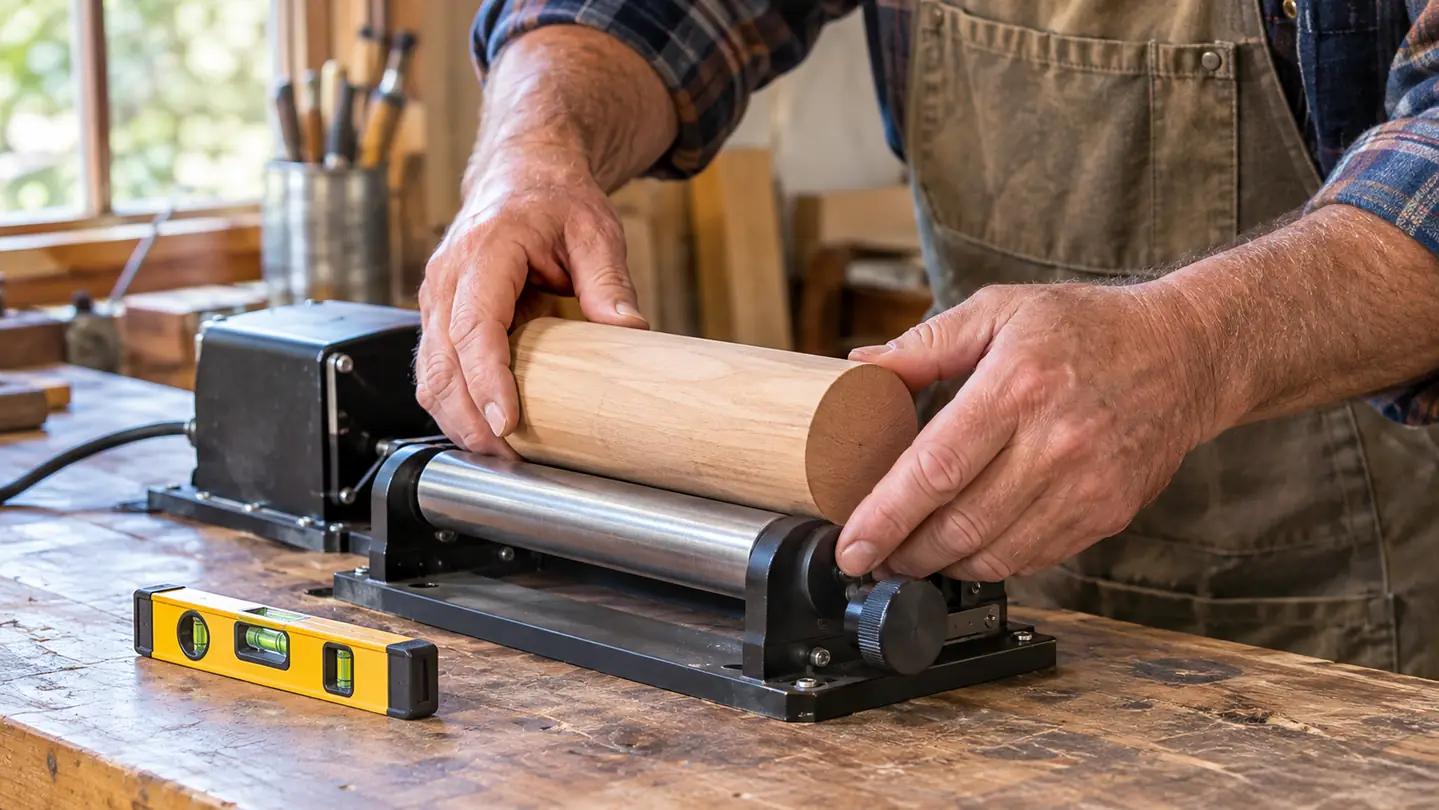
The RA2 Pro is a rotary attachment, not a laser. It takes the place of the flat bed and spins the work so the head can engrave around a curve instead of down onto a flat surface. The listing calls it a 4-in-1 and that is accurate: it arrives as a roller rotary, a chuck rotary, a sphere-engraving module and a ring-engraving stud, with a mini level and tape in the box. The roller is what handles tumblers and bottles. The chuck is what you want for tapered pieces and small rings. The sphere module handles round ornaments, which matters in December when Carol has a table at the church bazaar and wants something on it that is not a coaster.
Two numbers do more work than the rest of the spec sheet. The roller will crawl at 36 degrees per second and run up to 360 degrees per second. That range is the point. A tapered tumbler with a wrap design wants the slow end so the burn stays even all the way around. A run of ten straight-sided blanks wants the fast end so you finish before the garage goes cold. The listing gives a 40W power rating, a footprint of 7.4 by 3.7 by 18 inches, and that length on my bench is roughly a forearm and a half.
Compatibility is wide, but read it before you order: xTool S1, F1, F1 Ultra, P2, D1 Pro, M1 Ultra, and most laser engravers. On the S1 the riser is not optional. That is in the product title for a reason. I had my machine set flat, assumed the rotary would drop straight in, and it did not. Confirm you have the riser or order it on the same trip.
First assembly is a twenty minute job, not a two minute one. You set the unit on the bed, check it with the mini level, tape the leads down so they do not catch, and run a scrap blank to see where the focal point lands. Do that on a piece of scrap walnut before you touch anything you sold. The tape in the box is there for the cable, and it is worth using, because a lead that snags mid-job ruins the blank and the evening. My first attempt I skipped the level because the bench looked flat to me, and the bench was not flat. The test wrap came out wavy along the top edge and I spent an hour convinced the laser was out of focus before I thought to check the bubble. Ten seconds with the level and the second scrap came out clean.
The roller runs anywhere from 36 to 360 degrees per second. Your wrist runs at one speed, and that speed changes when the phone rings.
Where the xTool RA2 Pro Wins
Consistency first, because it is the thing you cannot fake by hand. Once the tumbler is chucked up and the level says you are true, the rotation is the machine's problem, not yours. Wrap a design all the way around and the start meets the finish. No stagger, no faint seam where you reset your grip. On a maple cutting board that does not matter. On a stainless tumbler where the design is the entire product, it is the difference between something a neighbor is glad to put on their desk and something they quietly set in the donate pile.
Last October I ran ten stainless tumblers for a neighbor who wanted them as thank-you gifts for his crew. Same wrap design, same speed setting, ten blanks in a row over two evenings. I checked the join on every one with a flashlight held at an angle, which is the only honest way to see a seam, and there was nothing to see on any of them. By hand I would have been three blanks in and already deciding which two to keep for myself.
Tapered work is the second win, and it is bigger than people expect. A tumbler that narrows toward the bottom will walk out from under a hand-turned setup. You end up chasing it, the design drifts, and the bottom half of the wrap sits lower than the top. The chuck holds the taper at the narrow end while the roller supports the body, so the blank stays where you put it. Wine glasses are the same story. I do not sell many, but the ones I have done since the rotary arrived came out straight the first time, and that was not true before.
Third is the one nobody puts in the listing: your hands come back to you. Ten identical tumblers used to be an afternoon of standing at the machine, holding and turning and counting. Now I load a blank, start the job, and use the time to wipe down the last one, box an order, or answer the door for a neighbor who wants a house number sign. The rotary does not make the burn itself faster. It makes the hours around the burn usable, and in a one-car garage that is most of the gain.
The chuck is the part I underrated. I thought I would use the roller for everything, and most weeks I do. But small rings, keychain fobs, and anything short and fat are miserable on rollers and easy in the chuck. Having both on the same attachment means I stop turning work away because the setup is awkward. That is a quiet kind of value. It does not show up in a photo, and it shows up every time somebody hands me something odd.
Where Hand-Turning Wins
I am not going to pretend the rotary wins everything, because it does not. Hand-turning costs nothing beyond the machine you already own, needs no riser, and takes no setup. A neighbor hands you a stainless tumbler on a Sunday and wants a name on it by Tuesday, and you can have it done in the time it takes to find your jig. That is a real advantage and I would not talk anybody out of it. There is also nothing on a hand-turned job that can go out of level or slip in a chuck, because there is no chuck.
A woman from the church bazaar brought me one stainless tumbler on a Friday and wanted her grandson's name on it for a Sunday birthday. No riser question, no level, no test circle on scrap. I set the blank on a folded shop towel against the bench edge, turned it by hand through the whole burn, and it was back in her hands before lunch. That is the job hand-turning was made for, and a rotary on the bench would not have made it any better.
Bench space is the other honest cost. Eighteen inches of bench in a one-car garage is not nothing. Mine shares a wall with the shop vac and a stack of maple offcuts, and there are evenings when I move three things to set the rotary down. If your work is mostly flat, cutting boards, slate coasters, leather patches, wooden signs, the rotary sits on a shelf for weeks at a time and you feel the space it takes every time you reach past it. Buy it because you have round work, not because it looks good in a video.
The seam stops being your problem
Roller, chuck, sphere module and ring stud in one attachment, with a mini level and tape in the box. Check whether your machine needs the riser before you order.
Amazon Check Today's Price on Amazon →
The Tapered Tumbler Problem, In Detail
If you only ever engrave straight cylinders, hand-turning holds up longer than people admit. The trouble starts with the tapered ones, and tapered is most of what sells at a craft fair. I have watched a blank creep under my hand a quarter inch across a four inch wrap, which is enough to make a clean design look sloppy. The chuck on the RA2 Pro grips the narrow end and the roller carries the weight. The mini level in the box is there for a reason, so use it. A rotary that is not level burns a wavy line and you will blame the laser for it.
I measured one of those blanks with calipers afterward to see whether I had imagined it. It was narrower at the base by roughly three sixteenths of an inch over four inches of height. That does not sound like much, and it is not much, until you remember the design does not know the blank changed size. A wrap that sits even at the rim is crowded near the bottom, and no amount of care in your wrist fixes geometry.
There is a second, quieter problem with hand-turning that took me a while to name. Your wrist does not hold a constant speed. It speeds up when you are bored and slows down when you are concentrating, and a laser engraver cares about both. That is why some hand-turned tumblers come out with a darker patch that has nothing to do with the design file. The roller runs at a set speed, anywhere from 36 to 360 degrees per second, and it does not get bored.
None of that means hand-turning is a beginner mistake. It is how most of us start, and it teaches you where the focal point wants to sit and how a curved surface takes a burn. I would rather see somebody sell twenty hand-turned tumblers and then buy the attachment knowing exactly why they need it, than buy it in week one and never learn what the machine is actually doing. The rotary is a tool for a problem you should already understand.
Who Should Buy Which
Buy the xTool RA2 Pro if round work is a real part of what you sell. Tumblers, wine glasses, ornaments, bottle openers, anything where the design wraps. Buy it if you have ever taken a second pass at a tumbler because the first one came out lopsided, or quietly sold one at a discount because of a band you could see and the buyer could not. Buy it if you run batches, since the setup is paid once and the tenth blank comes out as straight as the first. And buy it if you have the riser question answered, because that is the one thing that stops you cold on assembly night.
Stay with hand-turning if your work is mostly flat and the occasional cylinder is a favor rather than a product. Stay with it if the bench is already full, or if you are still deciding whether the laser side of this hobby is for you at all. There is no shame in turning a mug by hand. I did it for a year, sold plenty of them, and learned exactly what a rotary was going to be worth to me before I spent anything on one. That is the right order to learn it in.
You already know which tumbler came out crooked
Compatible with the xTool S1, F1, F1 Ultra, P2, D1 Pro, M1 Ultra and most laser engravers. Riser required on the S1. Roller, chuck, sphere module and ring stud in one box.
Amazon Check Today's Price on Amazon →