
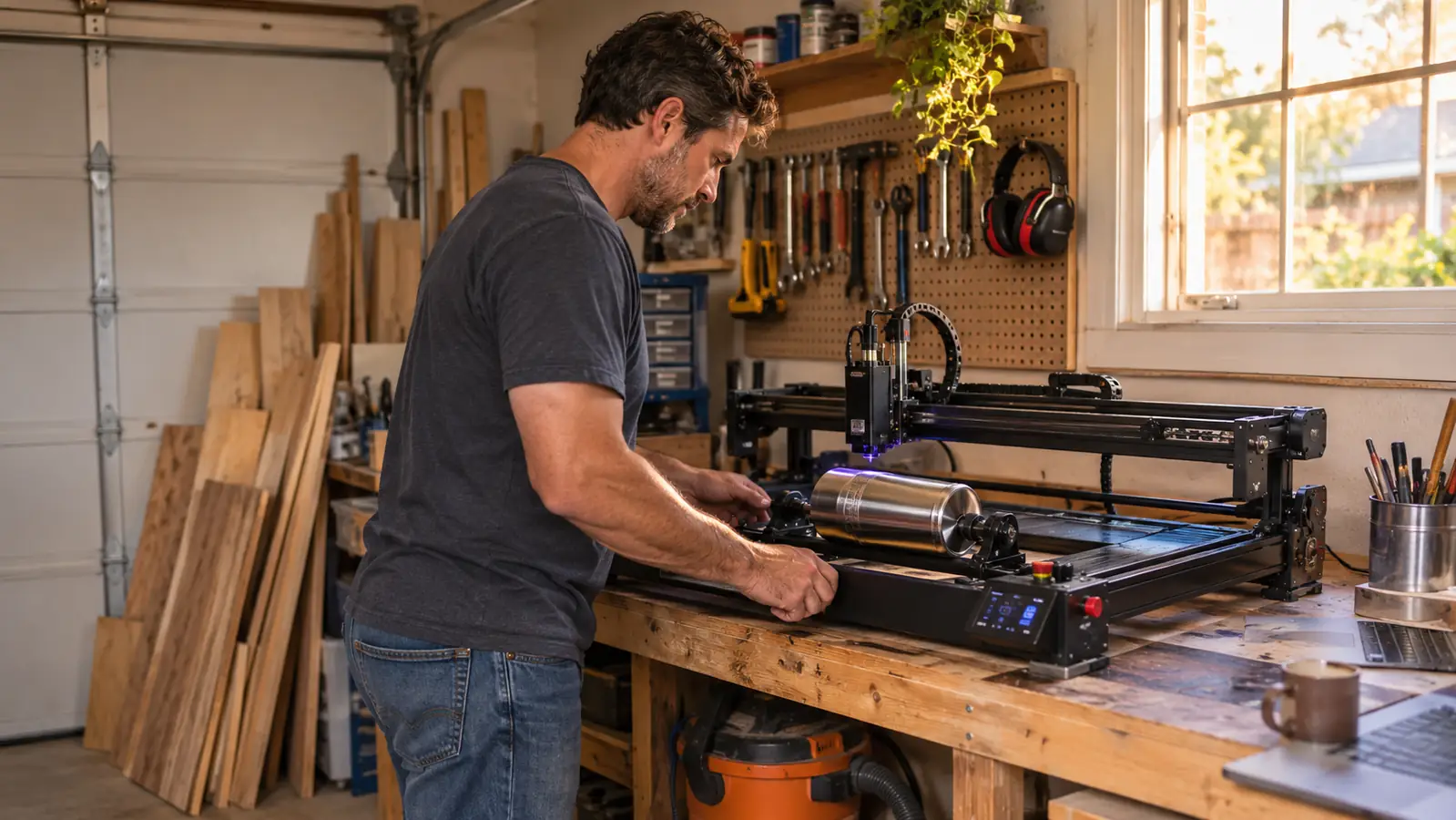
The first tumbler I ever engraved came out wavy. Not crooked enough to throw in the scrap bin, not straight enough to put on a table and take money for. I had been turning the thing by hand against the laser, restarting the job every time my wrist drifted a sixteenth of an inch, and I decided a powered roller had to be better than my forearm. It mostly is. The xTool RA2 Pro is the attachment that now lives on the bed of my laser whenever a job is round, and after a few months of weekends in the garage I have a fair picture of what it does well and where it still makes me earn it.
I work out of a one-car detached garage behind the house outside Harrisburg. Workbench along the back wall, a window I vent through, a shop vac that lives under the bench and complains about it. Cutting boards, slate coasters, leather keychains, and a steady run of stainless tumblers for craft fairs, church bazaars and neighbors who knock on the door with an idea. Round objects used to be the part of the week I dreaded. I would put them off until Thursday, run two, and spend Friday fixing the seams. Now they are the part I can batch, and the flat work gets done while the roller is still turning.
The Quick Verdict
Four rotary setups in one box, and the only one I have seen handle a tumbler, a wine glass and a ring without me inventing a workaround. It costs you a fiddly first evening and, on some machines, a riser you have to buy separately.
Amazon Check Today's Price →The attachment that ended my hand-turning days
Roller, chuck, sphere module and ring stud in one box, rated from 36 to 360 degrees per second. Check fit for your machine before you order.
Amazon Check Today's Price on Amazon →How I've Used It
The RA2 Pro does not arrive as a finished unit. It arrives as a box of parts: roller rotary, chuck rotary, sphere-engraving module, ring-engraving stud, a mini level and a roll of tape. You swap between them depending on what is on the bench that day. That swap is the whole story of this thing. It does four jobs well and it asks you to learn four setups to get there. xTool sells it as one accessory because the four setups share a mount, not because they share a technique, and that distinction is the source of every good and bad hour I have had with it.
The roller is what I use most, probably nine jobs out of ten. The object rests across two rollers and the laser focuses on the top of the curve. Stainless tumblers, wine glasses, a copper mug a neighbor brought over because his daughter wanted a date on it. You seat the object, check it sits level with the mini level that comes in the box, and let the rollers carry it around.
The first Saturday I had it, I ran a 20 ounce tumbler with a wrap design and botched the seam twice because I had the rotation speed turned up. Third pass, I dropped it slow, and the seam closed up clean. That was the entire lesson and I have not had to relearn it. My hand-turning days are done.
The chuck is for anything that needs holding rather than resting. Small cylinders, rings, a short piece of dowel where the roller would let the object walk. The chuck is adjustable and the Z-axis moves with it, so you can bring the work up to the focus point instead of chasing it with the head. I use it less than the roller, but when a job needs it, nothing else in the box will do. The job that sold me on it was a run of twelve short brass ferrules a neighbor wanted marked for a fishing rod project. On the rollers they would have walked sideways inside a minute. In the chuck they sat still for all twelve.
On time: a Saturday morning before a fair used to get me through two tumblers with a lot of swearing between them. The same morning now gets me through six, and the six come out straighter than the two did.
What the Four Configurations Actually Do
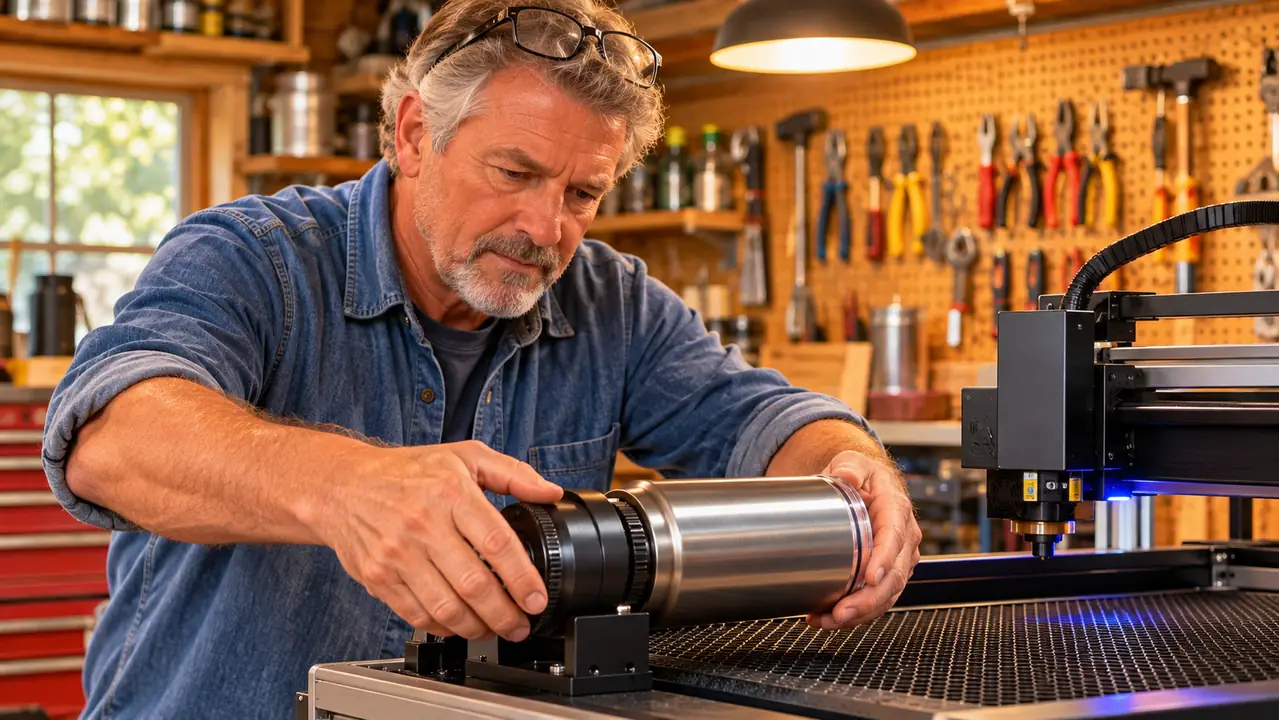
The roller rotary is the workhorse and the reason most people buy this. Two rollers, a gap you can work with, and the object turning under the head. It suits tumblers, glasses, mugs, bottles and anything that tapers gently enough to stay put. If the object has a handle or a heavy base, you need to think about clearance before you commit to a design, because the handle will come around and it will hit something.
The chuck rotary takes the object by the end and spins it on a fixed axis. That is the right tool for rings, short cylinders and anything where the roller would let the piece drift sideways over a long job. The adjustable chuck jaws take a range of diameters, and the adjustable Z-axis lets you line the work up with the focus. It is a more deliberate setup than dropping something onto rollers, and for a batch of twenty small pieces it is worth the extra two minutes.
The sphere-engraving module is the one I have used least, and I will say so plainly. It is built for spherical objects, and I do not get many of those. The one time I used it, on a turned wooden ball a neighbor wanted a monogram on, it worked and I have no complaints. I just do not have a use for it most weeks, and I would not buy this attachment for that module alone.
The ring-engraving stud handles bands and small rings, the kind of thing you engrave on the inside where nobody sees it until they take it off. It is the fiddliest of the four to line up and the most satisfying when it lands. The tape in the box is the sort of thing you ignore until the day you need to hold something steady, and then you are glad it was included instead of being a separate order.
Tumblers, Glasses and the Jobs It Opened Up
The honest reason I bought a rotary is that tumblers sell. At a church bazaar in the fall, a table with engraved stainless tumblers gets more attention than a table with flat signs, because people can pick a tumbler up and picture it in their truck. Before the RA2 Pro, I was limited to what I could hand-turn straight, which was not much and not repeatable. Now a design that works gets run eight or ten times and every one of them matches.
Wine glasses were the surprise. I did not expect to be good at them and I am still not fast, but a set of four glasses with a couple's name and a date on them is a wedding gift people ask for without blinking. The glass sits on the rollers, the curve is gentle enough that the focus holds across the engraving area, and the rotation speed keeps the line consistent around the bowl. That job is not possible by hand. The first set I did was for a neighbor's daughter, and I quoted her a week because I assumed I would break at least one along the way. I broke none, and the second set took an afternoon instead of a week.
Where it gets awkward is tapered drinkware and anything with a wide base and a narrow neck. A tumbler that tapers hard enough will ride up or drift as it turns, and you end up checking it every thirty seconds, which defeats the point. Very short objects are also a nuisance, because there is not enough body for the rollers to grip. I keep a short list of shapes I turn down now, and I would rather turn a job down than deliver a wavy line.
Setup, Repeatability and the Riser Question
The first evening with it was not fun. I had the roller in, the object on, the focus wrong, and a design running at a speed that made the tumbler blur. It took me about two hours to understand that the rotation speed is a setting I have to think about, not a fixed thing, and that a faster spin is not automatically a better one. I burned a perfectly good tumbler learning that. Once it clicked, the rest of the setups came quickly. Plan on losing an evening to the learning curve and plan on it being worth it.
The riser question is the one thing I would tell a buyer to check before ordering. This attachment is listed for the S1, F1, F1 Ultra, P2, D1 Pro, M1 Ultra and most laser engravers, and on some of those machines it needs a riser to clear the bed. xTool states it plainly in the listing and it is still easy to skim past. I read that line, ordered the riser alongside the unit, and then spent twenty minutes the first night wondering why the focus would not reach anyway. I would rather you read that line twice now than find out after the box is open.
Repeatability is where it earns its keep. I keep a notebook with the roller position, the rotation speed and the focus height for each shape I run regularly, and a job I have not done in two months goes back on in about five minutes. The unit itself is listed at 18 inches by 7.4 inches by 3.7 inches, so it takes real estate on the bed. On a small machine that matters, and I ended up rearranging my bench to give it a permanent home rather than putting it away between jobs. The shop vac moved to the other side. Carol noticed the change before I did.

Speed, Power and What Those Numbers Mean in Practice
The rating on this unit runs from 36 degrees per second at the low end to 360 degrees per second at the top. That is a wide range and most of my work sits in the bottom half of it. Faster rotation gives you a thinner, more stretched engraving line because the surface is moving under the head, and slower rotation gives you more overlap and a darker mark. If you are engraving on stainless with a coating, slow is your friend.
The 40W power rating is the motor on the rotary, not your laser, and it is worth being clear about that so nobody expects this box to make their machine cut deeper. What the 40W buys you is a unit that turns a heavy stainless tumbler without stalling or shuddering at low speed, which is exactly where a weaker roller gives up. I have run a full 20 ounce tumbler at a crawl for a long job and it held steady the whole way.
I would not spend a lot of time hunting for the perfect speed setting. Start slow, run a test on a scrap tumbler of the same material, and adjust once. What matters more is that the object sits level and that the rollers are clean. A bit of grit on a roller will show up in the engraving as a wobble you can see from across the room.
What I Liked
- Four setups in one box: roller, chuck, sphere module and ring stud
- Holds heavy stainless tumblers steady at low rotation speeds without stalling
- Adjustable chuck and adjustable Z-axis make repeat jobs quick to line up
- Mini level included, which sounds trivial until you are chasing a wavy line
- Compatible with a wide list of machines, including the S1, P2, D1 Pro and M1 Ultra
Where It Falls Short
- First setup will cost you an evening of getting the speed and focus wrong
- Needs a riser on some machines, which is easy to miss before ordering
- The sphere module is dead weight for anyone not engraving spheres
- 18 inches of bed space is a real commitment on a smaller machine
- Tapered drinkware and very short objects still fight the rollers
A tumbler that used to take me four restarts and a fair amount of luck now runs in one pass, and the only thing I still check by eye is the seam where the design meets itself.
Who This Is For
If you already own an xTool machine and you have turned down round jobs because doing them by hand was not reliable, this solves that specific problem and solves it well. That includes anyone doing craft fairs with tumblers, anyone taking wedding and anniversary orders on glassware, and anyone who wants to batch the same design ten times and have all ten match. It also suits the person who likes having the right tool for the odd job, since the chuck and ring stud mean you are not stuck when something small and round shows up.
Who Should Skip It
If your work is flat, skip it. Cutting boards, slate, leather patches, wooden signs: a rotary does nothing for you and the bed space is better spent on material. Skip it too if you are not willing to lose an evening to the learning curve, because the first session is genuinely annoying and the payoff comes on the second one. And if your machine needs a riser and you are not prepared to buy one, sort that out first, or you will have an expensive box sitting on the bench waiting.
If round jobs keep walking away from your table, this is the fix
The RA2 Pro handles tumblers, glasses, rings and small cylinders on one mount. Confirm your machine and whether it needs a riser before you order.
Amazon Check Today's Price on Amazon →