
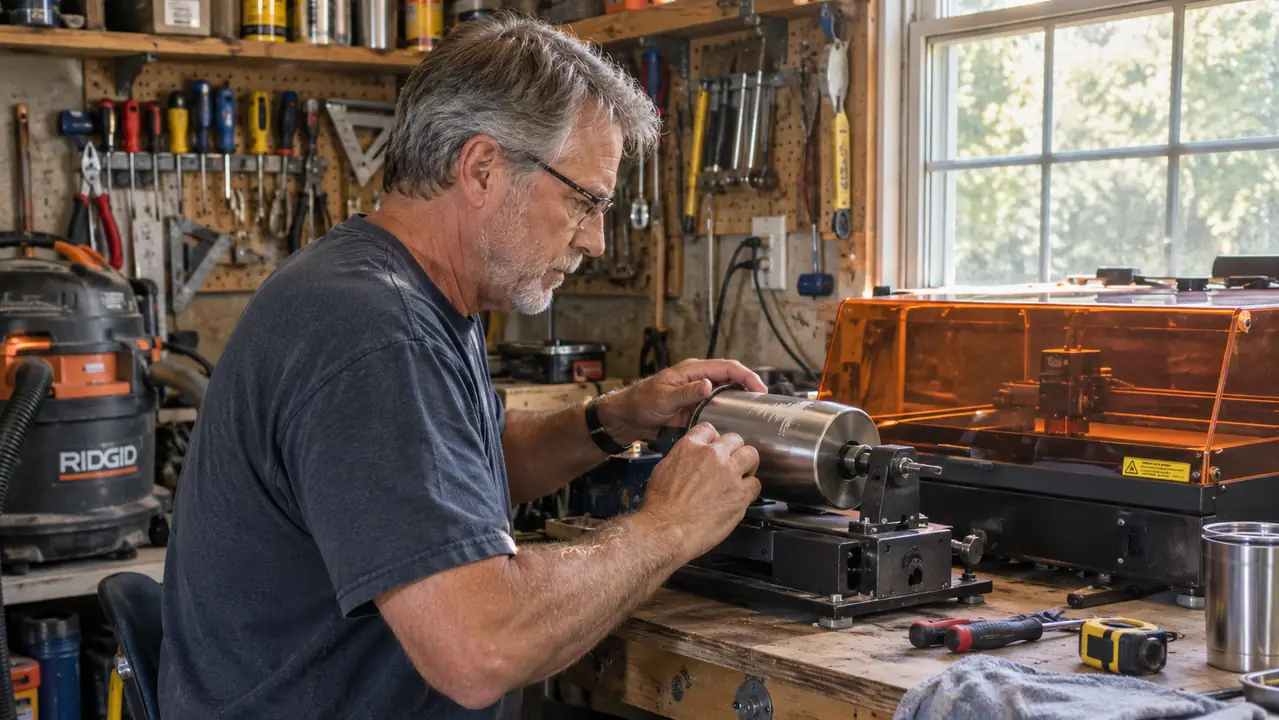
I bought the xTool RA2 Pro about a year into engraving, back when every tumbler on my bench got turned by hand. You hold the cup, you rotate it a few degrees, you fire, you rotate again. Do that once and you feel clever. Do it eight times in an evening and you feel like a machine that is about to make a mistake. The RA2 Pro is the piece of gear that took that job off my hands, and it is the reason I can say yes when a neighbor asks for a batch instead of clearing my whole weekend first.
For anyone new to this: a rotary attachment holds a round object and turns it under the laser, so the artwork wraps around the full circumference instead of sitting flat on the bed. xTool built this one as a 4-in-1 unit with a roller rotary, a chuck rotary, a sphere-engraving module and a ring-engraving stud, plus a mini level and tape in the box. Here are ten reasons it pays off for a small side business, roughly in the order I noticed them in my own garage.
One tumbler by hand is a hobby. Eight is a job. This is the attachment that let me take the eight.
The RA2 Pro is listed for the xTool S1, F1, F1 Ultra, P2, D1 Pro and M1 Ultra, and for most laser engravers. It must be used with a riser, so confirm yours before ordering.
Amazon Check Today's Price on Amazon →It stops a round blank from drifting mid-pass
A hand-turned tumbler drifts. Not much, maybe a sixteenth of an inch, but on a wrap of small lettering that is enough to leave a visible step where the pattern should have met itself. The roller holds the cylinder at two points and turns it at a rate the machine controls, so the position you set at the start is the position you get at the end. My first wrapped tumbler on the roller had no seam. That sounds like a small thing until you have sanded down and re-blanked a cup over one.
Four attachments in one box, so you are not buying twice
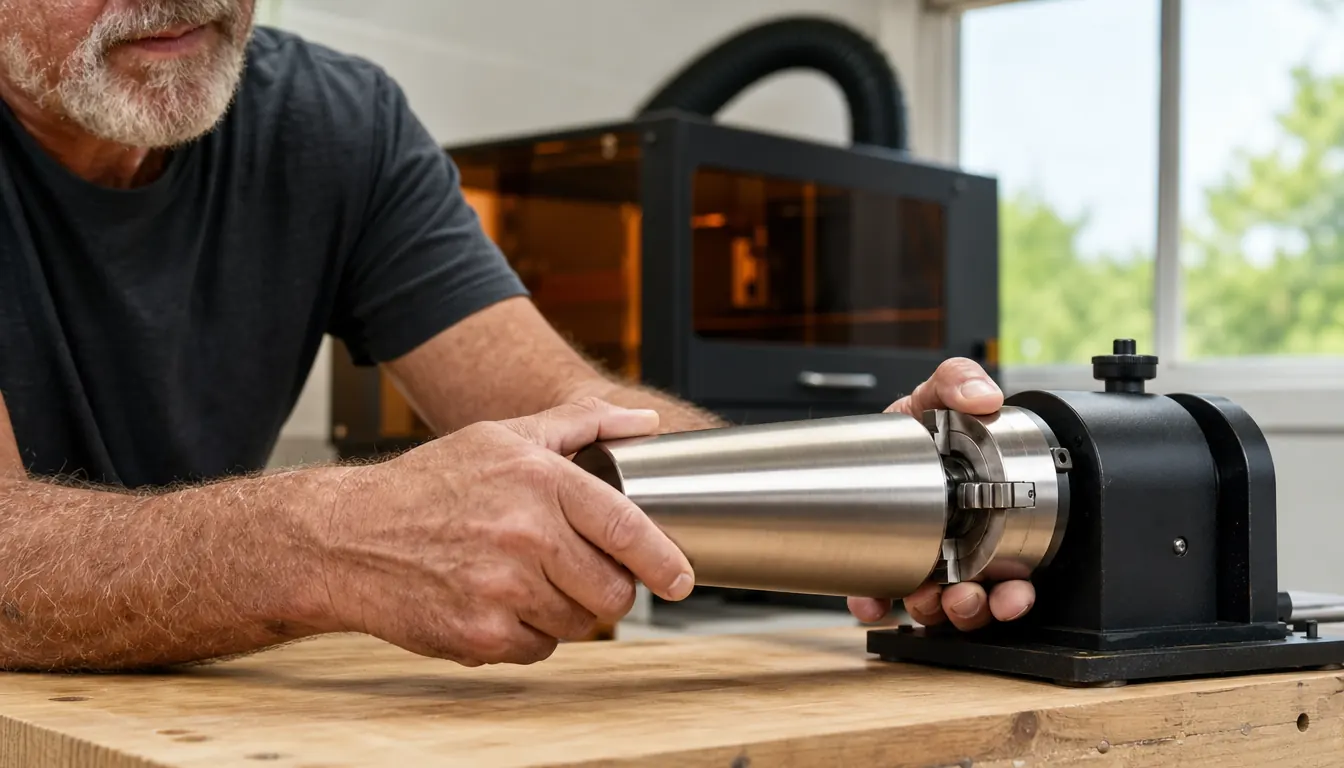
The box includes the roller rotary, the chuck rotary, the sphere-engraving module and the ring-engraving stud, along with a mini level and tape. I have watched people buy a roller, discover they need a chuck for tapered cups, and end up with two units on the shelf. This one covers the four jobs I actually run into. The mini level earns its keep more than you would expect, because my workbench is not perfectly flat and it never has been.
The chuck handles the tapered tumblers a roller cannot
Most travel tumblers taper toward the base. Put one on a roller and it wants to walk toward one end. The chuck rotary grips the piece from the end instead, so the taper stops mattering. That matters for the business side, because the tapered cups are the ones people ask for. I run the roller for straight-sided stainless and the chuck for anything with a shoulder, and I stopped turning down orders based on the shape of the cup.
A speed range from fine-detail crawl to a full turn per second
The listed maximum rotational speed is 360 degrees per second, which means a complete revolution in one second at the top end. The minimum is 36 degrees per second. Those two numbers cover the work I do. Slow for fine lettering and small logos, faster for a wrap of larger text where I care about coverage more than detail. Moving between the two without swapping hardware is most of the value of having a driven rotary at all.
Patterns close cleanly where the wrap meets itself
On a cylinder, the seam is where a wrap job lives or dies. Either the last line meets the first line or it does not, and no amount of sanding hides it. Because the rotation is driven and repeatable, the start and the end of a wrap land where you planned them. I run a light test on a scrap of the same diameter before a run of good blanks. Since I started doing that with the roller, I have not had to scrap a finished tumbler over a mismatched seam.
Twelve tumblers used to eat a whole Saturday. The roller does the turning now, and I stand there and inspect.

It fits the machines people actually own
Compatibility is where accessories usually disappoint. This one is listed for the xTool S1, F1, F1 Ultra, P2, D1 Pro and M1 Ultra, and xTool says it works with most laser engravers. One thing to know before you order: it must be used with a riser. That is not optional and it is easy to miss. If your machine is already raised you are set. If it is not, put the riser on the same order, because the rotary will not sit at the right height without it.
The adjustable chuck and Z-axis take the guesswork out of height
Round objects come in different diameters, which means the top of the work sits at a different height every time. The adjustable Z-axis and chuck let me set the piece where the machine expects it instead of stacking scrap under the blank and hoping. I keep a page from a notebook taped to the bench with the settings for the sizes I run most. On a repeat job, setup is a couple of minutes instead of a ten-minute experiment.
Batches repeat because the setup repeats
The reason a rotary pays off for a side business is not the first tumbler, it is the ninth. When the same fixture holds the piece the same way every time, a run of twelve identical cups comes out identical. I did a set of twelve for a church bazaar last fall and every one matched. That is not a skill I have. That is a fixture that does not move between pieces. Repeatability is what you are buying here, more than raw speed.
It opens up the whole round shelf of products
Once you can hold a cylinder, a sphere and a ring, the product list widens. Wine glasses, straight tumblers, tapered tumblers, small wooden rounds, and with the sphere-engraving module, round ornaments for the holidays. The ring-engraving stud handles the inside of a band. I will not pretend I sell a lot of engraved rings, but the sphere module earned its bench space in December, and the glassware work came out of the same attachment that turns tumblers.
The payback shows up in hours and saved blanks
I do not quote income, because a side business like this swings with the season and with how many fairs Carol and I decide to book. What I can count is hours and materials. Before the roller, a tumbler took me close to twice as long and I lost the occasional blank to a seam error. The unit itself measures about 7.4 by 3.7 by 18 inches, so it lives on a shelf under the bench when it is not mounted, which in a one-car garage matters as much as anything else on this list.
What I'd Skip
If you only engrave flat stock, this attachment will sit on a shelf. Cutting boards, slate coasters and leather keychains do not need it, and I would rather you spend the bench space on a better ventilation setup. If you turn one tumbler a month, hand turning is honestly fine. And if you have not bought the riser for your machine yet, budget for that before you budget for this, because the rotary needs it to sit at the right height. The other real limit is setup: every diameter change is a fresh setup, and on a tired night that is the step I rush and then regret.
None of this makes the machine smarter. It makes round work repeatable, and repeatable is the difference between agreeing to a batch order and finding a reason to dodge one.
If the batch order is the part you want, this is the part you buy first.
Roller rotary, chuck rotary, sphere module and ring stud in one unit, rated from 36 to 360 degrees per second. Remember the riser.
Amazon Check Today's Price on Amazon →