Short answer first, because that is why you clicked. For the work most of us actually do, the Twotrees TTS-10 Pro is the machine to buy: cutting boards, slate coasters, powder-coated tumblers, leather keychains, small wooden signs. A budget CO2 hobby laser does not beat it at any of that. The CO2 beats it at exactly one thing, and that thing is cutting. If your orders are stacks of acrylic and plywood cutouts, buy the CO2 and accept the plumbing. If your orders are engraved gifts, buy the Twotrees and skip the bucket. The rest of this is me explaining which of those two you actually are.
Some credentials, so you can weigh what follows. I am Lenny Sorensen. I run a diode laser out of a one-car detached garage behind my house outside Harrisburg, Pennsylvania. Workbench along the back wall, a window I vent through, a shop vac that earns its keep. Three years at it now, selling at craft fairs and church bazaars and taking custom orders from neighbors. I have never owned a CO2 machine. I have watched them run and I know what they demand, because I spent thirty years as an HVAC technician and my whole working life has been around equipment that needs water and venting. So read the CO2 half of this as category knowledge, not a review of one specific cabinet.
| Twotrees TTS-10 Pro | Budget CO2 hobby laser | |
|---|---|---|
| Work area | 300 x 300mm, about 11.8 x 11.8 inches | Usually around 300 x 200mm on a starter cabinet |
| Cutting quarter-inch plywood | Several passes, browned edges that need sanding | One or two passes, clean kerf |
| Clear acrylic | 450nm diode light passes through it instead of cutting | Cuts clean, leaves a frosted edge |
| Cooling | Air cooled, nothing to plumb | Glass tube needs a pump and a reservoir |
| Setup on day one | Assembly tools, air assist pump, TF card and card reader in the box | Tube, water, alignment and venting before the first cut |
| Fumes and enclosure | Open frame, you build the venting and the habits | Cabinet with a lid and a hose to the window |
| Bench space | Sits on the bench, listed at 10 x 4.97 x 7 inches | Wants its own table or a piece of floor |
| Warranty | 1 year | Varies by seller, and the tube is often treated as a wear part |
| Running without a computer | TF card and card reader included | Usually tethered to a PC |
| Best for | Coasters, boards, slate, leather, signs, tumblers | Acrylic, plywood cutouts, batch production |
Where the Twotrees TTS-10 Pro Wins
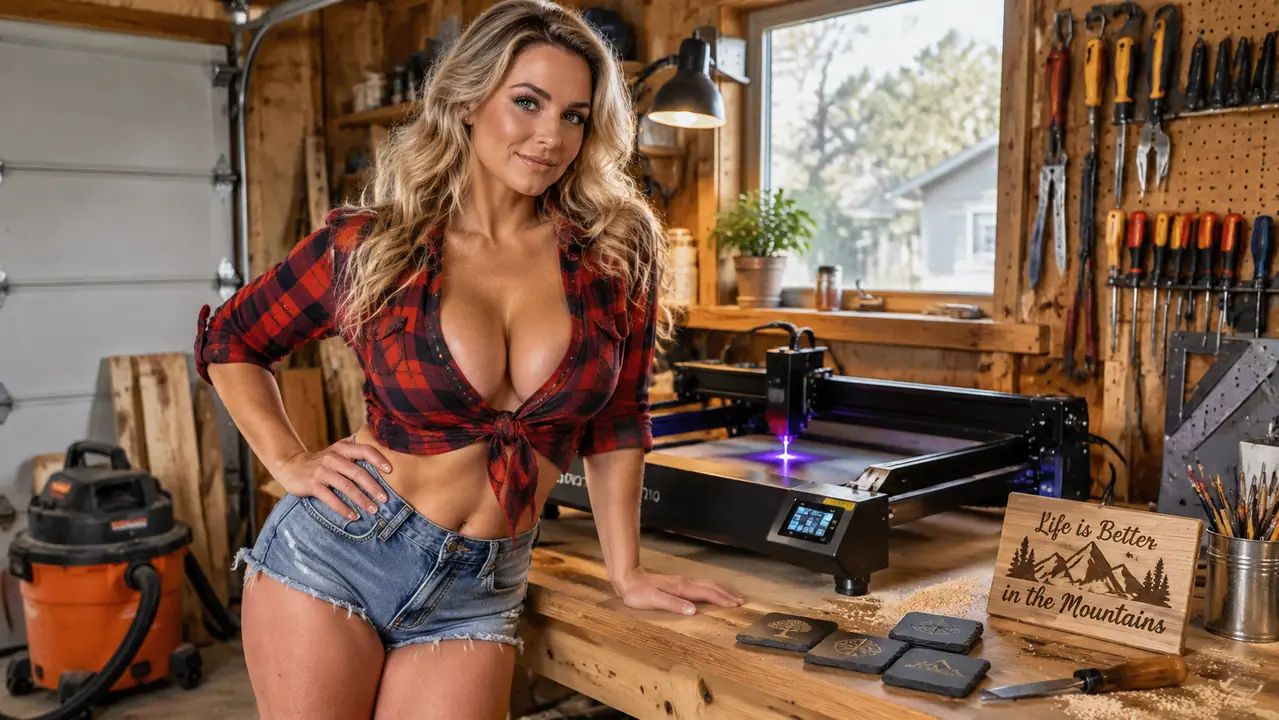
Footprint and setup, first, because that is what decides whether a machine becomes a habit or a dust collector. The TTS-10 Pro sits on the bench. Listed dimensions are 10 by 4.97 by 7 inches, corded, 24 volts, and it goes together with the assembly tools that come in the box. No tube to align, no water to mix, no pump to prime. I had mine burning a test grid the same evening I unboxed it. A CO2 cabinet wants its own table, a clear run to a window, and most of them want a weekend before you trust them with a paying order.
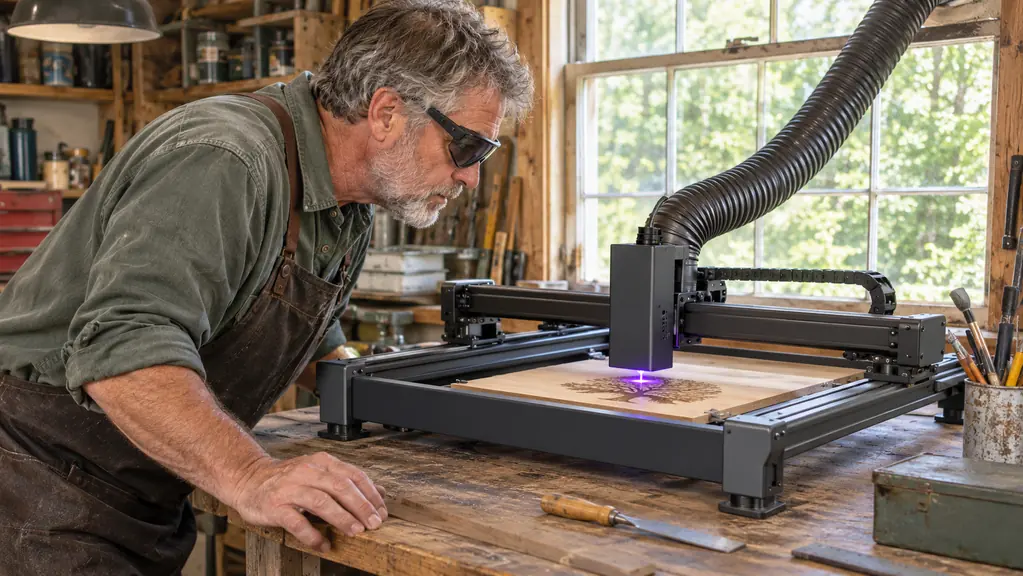
Assembly took me a little over an hour, and forty minutes of that was me re-reading the sheet and laying the hardware out in the order I wanted it rather than the order it came in the bag. The frame squares up with the tools they give you. After that it is the vent hose, a test burn on a scrap of pine, and you are working. What surprised me was the noise, which is mostly the air pump and the fan, quiet enough that I can hear the radio on the shelf behind me while it runs. That matters more than it sounds. A machine you can stand next to for two hours without wanting ear plugs is a machine you will actually use on a Tuesday night.
The work area is 300 by 300 millimeters, about 11.8 inches square, and that number is honest in both directions. Big enough for a slate coaster, a leather patch, a small sign blank, a six-inch walnut board. Not big enough for a full-size maple cutting board in one pass. I tile those with a repositioned file, or I use smaller blanks and call them cheese boards, which is what people buy anyway. The 10W optical diode at 450nm engraves deep enough on wood and slate that I am not fighting for contrast.
The mainboard is a 32-bit dual-core, and I will not pretend I understand the electronics of it. What I notice is that it keeps up. Long jobs with a lot of direction changes do not stutter, and file handling stays simple: TF card, card reader, done. The air assist pump and tubing come with the machine, which matters more than a spec line suggests. Air on the lens keeps smoke off the optics and gives you a cleaner line. Plenty of sellers charge extra for that.
Where a Budget CO2 Laser Wins
Cutting. That is the whole answer, and it is not a small one. A CO2 tube gets through quarter-inch plywood in a pass or two with a kerf you can work with. My diode will get through it, slowly, in several passes, and the edge comes out browned and needs sanding before anyone sees it. If someone orders twenty plywood cutouts for a school event, the CO2 finishes before my machine has warmed up. If your plan is to sell cut shapes, ornaments, stencils or acrylic signage, the diode is the wrong tool and no amount of patience fixes that.
I know this from one job, early on, when a neighbor asked for a set of name plaques for a family reunion and I said yes because they were small and I was eager. Two passes turned into six. The edges came out dark and slightly rounded, and I spent a whole evening with a sanding block and a roll of paper getting them presentable. They were fine in the end, and she was happy, but the hours that job ate taught me more than any spec sheet. I have been slower to say yes to plywood ever since, and when I do I quote the sanding time in my head before I open my mouth.
Clear acrylic is the second place it wins, and this one is physics rather than preference. Diode light at 450nm passes straight through clear acrylic instead of biting into it. A CO2 cuts it and leaves a frosted edge that looks deliberate. That single difference decides whole product lines. Cake toppers, acrylic keychains, layered signs, the clear blanks people pick up at the craft store: all CO2 work.
Third is the cabinet. A budget CO2 machine is a box with a lid, and a lid is worth something. The work happens enclosed, the smoke goes up a hose to a window, and you are not leaning over an open beam. Do not oversell it. Cheap cabinets leak at the seams and the lid switches on some of them get bypassed by owners within a week. It is a better starting posture than an open frame, not a guarantee. With the Twotrees you are the enclosure, which means glasses on every time, including the two-minute job.
If your order book is boards, coasters and signs, start with the machine that needs no water
The Twotrees TTS-10 Pro gives you 300 x 300mm of work area, a 10W optical diode, air assist in the box and a 1 year warranty. It sits on a bench, plugs into the wall, and goes to work the same evening.
Amazon Check Today's Price on Amazon →What a Saturday of Orders Looks Like on Each
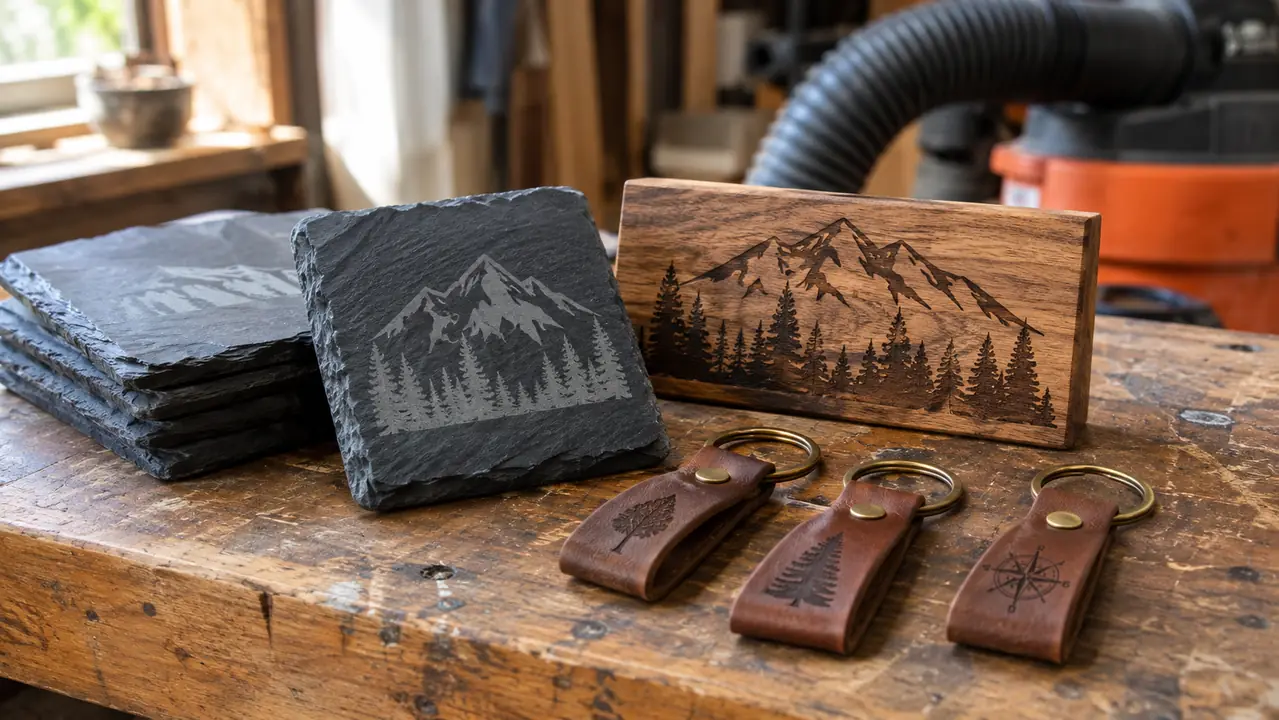
Say you have six slate coasters, four powder-coated tumblers, a batch of leather keychains and one walnut board to engrave by Sunday. On the diode that is a comfortable day. Coasters go four at a time inside the 300mm square, and you get to the point where you set the file and walk to the bench with a coffee. Keychains are quick. The tumblers are the fiddly part, since they are round and the focus shifts across the curve, so I run them one at a time and check the first before I commit to the rest. The board is the last job of the day and it takes the longest.
The order I actually run is coasters first, while the garage is still cold and the machine is fresh, then keychains, then tumblers once I have my glasses seated properly and my patience topped up, then the board last with the window open and the fan on. It sounds fussy written down. It is really just the sequence I settled on after one Saturday where I did the tumblers first, chased focus around four curves for an hour, and then had nothing left for the part of the job that rewards paying attention. Now I front-load the easy work and save my temper for the round stock.
Now the same Saturday with a stack of acrylic and plywood instead. On the diode that day does not finish. You will run five or six passes on the plywood, sand the char off every piece, and lose the afternoon to a single order. On the CO2 the cutting is the fast part, and the afternoon goes to weeding and packing. Same hours, different order book. That is the real decision, and it has nothing to do with which machine is better built.
Where people get this wrong is buying for the machine they think they will become. A diode owner who suddenly lands an acrylic job does not need a new laser. He needs to pass on the job or farm it out and stay honest with the customer. A CO2 owner who mostly engraves slate has bought himself a plumbing project to do work a bench machine handles quietly. Match the tool to the orders you have, not the ones you are hoping for.
Eleven and eight-tenths inches square is not a limit you fight. It is a limit you learn to batch around.
The Overhead Nobody Lists
Every machine has a second job attached to it, and the listing does not mention it. On the diode, the second job is air and eyes. You keep the window open, you run the shop vac, you wear glasses rated for the wavelength, and you learn not to stand in the beam path. The air assist pump that comes with the Twotrees handles smoke at the lens, but it does not vent your garage. I built a hood out of duct parts and an inline fan, and I check the window seal every fall before the cold sets in.
That hood is nothing clever, but it took two tries. A four inch takeoff, a length of flexible duct, and an inline fan I had left over from my working days, wired to a switch screwed to the bench leg. The first version pulled straight up from behind the frame and the smoke still curled forward over the front edge and into my face. Moving the takeoff six inches forward, so it pulls across the work instead of away from it, was the fix. Anyone who has done residential ductwork will recognize that lesson. Capture beats volume, and it beats it cheaply.
On the CO2, the second job is water. A glass tube wants a pump and a reservoir, and that water has to stay cold through a long run. People use a bucket and ice, which works right up until it doesn't, and then the tube is done. Distilled water, never tap. The tube is also the part that ages, which is why it is usually treated as a wear item and why the warranty conversation gets complicated the day it dims. None of that is a reason to avoid a CO2. It is a reason to know what you are signing up for.
Then there is the ordinary stuff. Lenses need cleaning. Beds need leveling. Masking tape is a consumable in this house the way flour is in a kitchen. Neither machine escapes any of it. What changes is how much of your week goes to upkeep versus orders, and for a weekend operation that ratio is the whole ballgame.
What I Liked
- Fits on a workbench in a one-car garage
- No water, no pump, no reservoir to babysit
- 300 x 300mm work area covers coasters, small signs and board sections
- Air assist pump, TF card and card reader included
- 1 year warranty
Where It Falls Short
- Open frame, so eye protection and venting are on you
- Will not cut clear acrylic at all
- Cuts quarter-inch plywood slowly, with char on the edges
- Full-size cutting boards need tiling or a smaller blank
- Round tumblers take patience because the focus shifts across the curve
Who Should Buy Which
Buy the Twotrees TTS-10 Pro if your work is engraving rather than cutting. Coasters, cutting boards, slate, leather, wooden signs, tumblers, gifts for a table at the church bazaar. Buy it if your shop is a bench in a garage with one window, if you do not want to plumb water into a space that freezes in January, and if 300 by 300mm covers the blanks you actually sell. The 1 year warranty plus air assist, TF card and reader in the box make it a low-friction first machine, and 731 reviews sitting at 4.2 tells you it is neither a wonder nor junk. It is a working tool with real limits.
Buy the budget CO2 if you sell shapes. Acrylic, plywood, ornaments, layered signs, anything where the cut edge is the product. Buy it if you can give it a table against a wall, a window for the hose, and a spot to keep a reservoir of water. Buy it if you are doing volume, because the speed difference on thin material is not marginal and it decides whether an order is worth taking at all. If you are not sure yet, start on the diode, learn what people ask you for, and let the order book tell you when to move.
One machine, one bench, one window, and no bucket of water to change
If your first year is engraving gifts, coasters and small signs, the Twotrees TTS-10 Pro covers 300 x 300mm with a 10W optical diode and air assist in the box. You can add a cutter later. You cannot easily get back a season spent plumbing.
Amazon Check Today's Price on Amazon →