

Nobody warns you that the smoke is the thing that decides whether a home engraving setup survives. I run a small laser engraving operation out of the one-car garage behind my house outside Harrisburg, maple cutting boards, slate coasters, stainless tumblers, leather keychains, and a few wooden signs for the church bazaar crowd. Three years in, the machine work is fine. The air was not. My wife Carol could tell I had been out in the shop from the kitchen, and that is a bad sign when your shop sits thirty feet from the back door. That is what got me looking at the SainSmart Smoke Purifier in the first place.
This is not a puff piece. I bought the unit, I have run it through a few months of real orders, and I have a list of complaints I would want to hear before I spent my own money again. Some of what follows is praise and some of it is me standing in a cold garage at nine at night wishing the thing worked differently. If you want the short version it is right below. If you want the version that keeps you from wasting a Saturday, keep reading.
The Quick Verdict
It clears smoke and odor out of garage air better than I expected from something this small. It also has a consumable filter, a single button, and a capture range short enough that where you put it matters more than any number on the box.
Amazon Check Today's Price →The Filter Stack Is the Real Story, Not the Fan
Five layers, three speeds, and a 0.3 micron rating are the details that decide whether this works in your shop. Read the current listing and today's price before you commit bench space to it.
Amazon Check Today's Price on Amazon →What the SainSmart Smoke Purifier Actually Is
Strip away the marketing language and this is a small portable fume extractor. The listing describes a five-layer filter system, and the filter types it names are a pre-filter, HEPA, and activated carbon. It is rated to hold particles down to 0.3 microns, and the contaminants it lists are cigarette smoke, dust, odors, and pet dander. Control is a push button on the unit with three speeds. SainSmart rates the noise at 35 dB and the weight at 1.8 kg, and the included components are listed as the main body.
Two things about that list matter more than the rest, and the listing does not dwell on either. The first is that the contaminants it names are smoke, dust, odor and dander, which is precisely the mix you produce burning wood and leather in a closed room. The second is that the box contains the main body. Plan around that sentence before you order, because a filter unit that is not sitting in the right place is just a fan with a nice filter in it.
I came at this from a career in HVAC, so I have a bias and I will name it. I have installed more filter racks than I can count, and I know what a small carbon bed does and does not do. That background made me skeptical of a unit this size. It also made me put it in the right spot on the first day, which I suspect is why my experience has been better than some of the reviews I read after the fact.
How I've Been Running It in the Garage
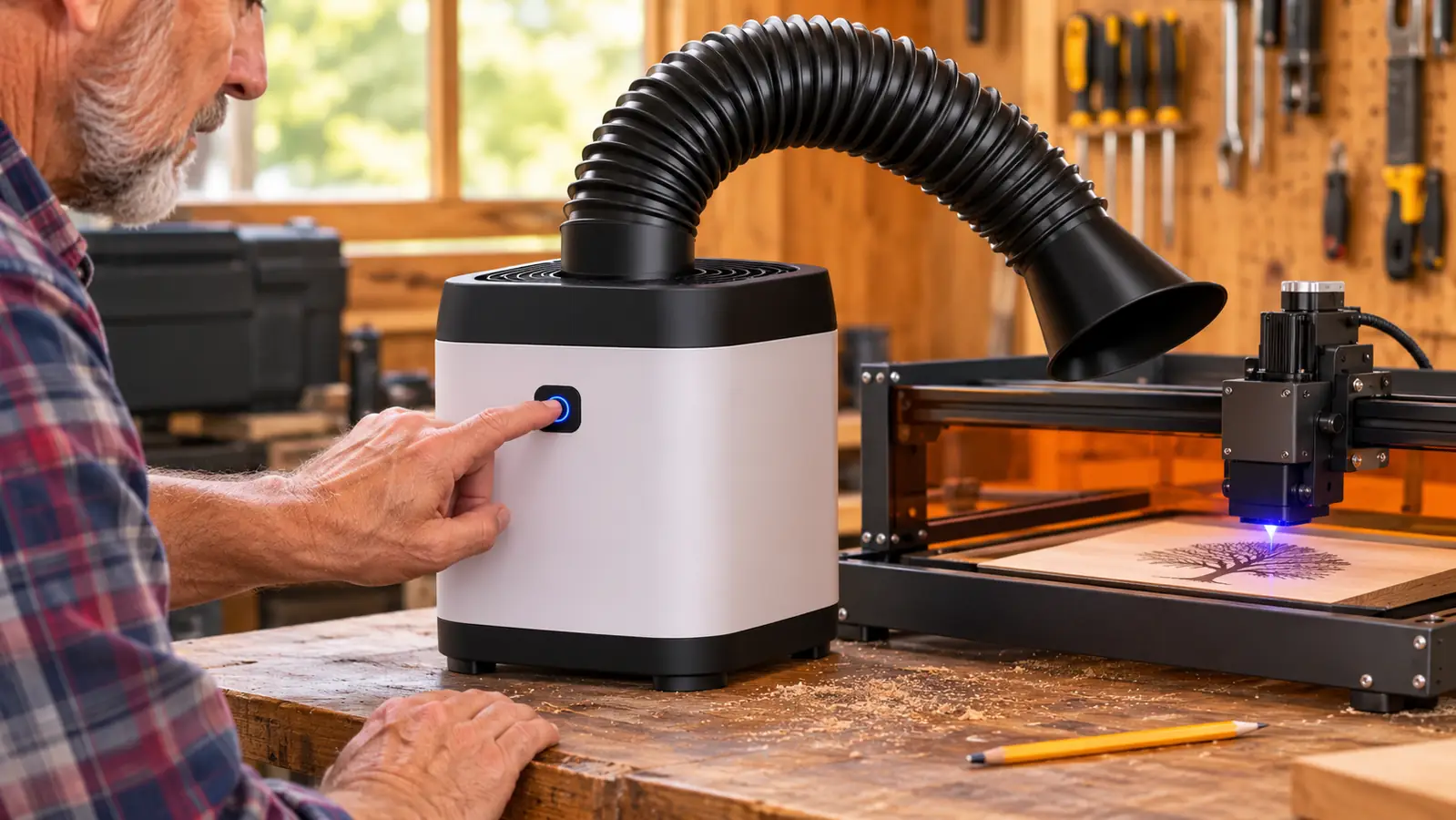
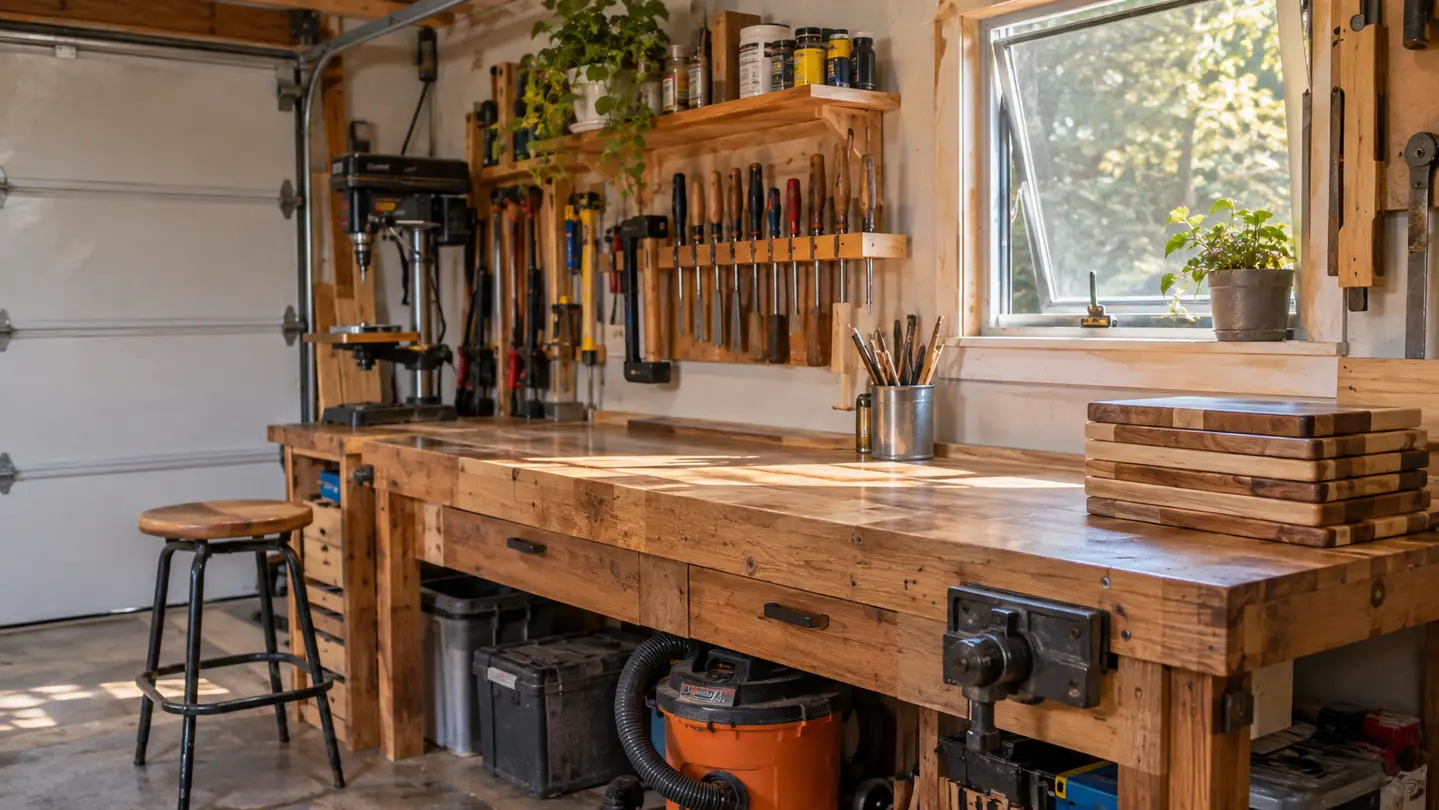
My bench runs along the back wall under the window. The engraver sits at the left end, the shop vac lives underneath, and the purifier sits to the right of the machine at roughly the height of the cutting bed. That position was not an accident. Smoke comes off the cut and rises, and if you pull from just above and to the side you catch it on the way up instead of waiting for it to reach the ceiling and spread out into the room.
The first week I had it, I did it wrong. I set the unit at the far end of the bench because that was where the outlet was, ran a batch of slate coasters, and came back an hour later to a garage that still smelled like a burnt match. Nothing was broken. The smoke was simply rising out of reach before the intake ever saw it. I moved it twelve inches closer to the head, propped it on a scrap of two-by-six, and the same job on the same setting cleared noticeably better. That is the entire lesson with a unit this size, and it cost me one evening to learn it.
The three speeds are set with a push button on the unit. I run the lowest speed for slate coasters and leather, because those put out more smell than visible smoke, and I move up to the second speed for maple and walnut boards. The top speed is for the long twelve-by-eighteen boards that run the longest and put out the most. The button cycles through the speeds and that is the entire interface. Nothing to program, nothing to bump with a board, nothing to lose.
What surprised me is how much work the lowest speed does. I expected to run it flat out all the time and it has not worked out that way. On low I can stand at the bench and have a normal conversation with Carol when she comes out to look at a design, and the air at nose height stays clear. That is the whole point as far as I am concerned. If a machine is too loud to leave running, you turn it off, and then it is doing nothing for you.
The Five-Layer Filter and What It Really Catches
Five layers sounds impressive until you remember what a filter stack has to do. The pre-filter takes the big stuff, the HEPA layer catches the fine particles, and the carbon is the part that handles odor. SainSmart rates particle retention at 0.3 microns, which is in the range where wood smoke and fine ash live. That rating is the one number on the box I actually care about, because the visible smoke is the least of your problems. The particles you cannot see are the ones that hang in the air for hours after you have shut the machine down.
The carbon is the layer that sold me, and it is also the layer that will decide whether you stay happy with this unit eighteen months from now. Carbon works by surface area and it gets used up. It does not clean itself and it does not last forever. There is no gauge on this unit telling you the carbon is spent, so you have to notice the smell coming back and connect the dots yourself. In my experience the odor returns first, well before the visible smoke gets bad again.
The first month I kept a scrap of paper on the bench and marked down the sessions. What I found is that the stack held up through a long run of coasters and keychains and started to soften on a stretch of heavier board work. That is not a knock on the filter, it is how carbon behaves. If you do light work in a home shop, the filter will last you a good while. If you are burning boards every night, plan on buying filters the way you plan on buying blanks.
I also learned that leather is the material that tells you the truth about your filter. Wood smoke you can see. Leather smoke you smell, and it hangs in the air and in your clothes. Back in February I ran a batch of forty leather keychains across two evenings, and by the second evening I could smell it on my sleeves when I came back through the kitchen door. That was the carbon telling me it was near the end, not the HEPA layer. So if you cut a lot of leather, budget your filters around that work and not around the boards, because the boards will happily outlast the carbon.
Noise, Buttons, and the Little Things That Bug Me
SainSmart rates this at 35 dB and I will tell you straight that a rating and a room are two different things. Thirty-five decibels is about the level of a quiet conversation. In an empty garage with hard walls, the unit reads louder than that to my ear, and the top speed is the one you notice. It is not painful and it is not the loudest thing in the shop, but if you were picturing this next to a desk in a spare bedroom while you take a phone call, think again.
The button is my real complaint and it is a small one. There is one button on the unit and it cycles low, medium, high. If you want to go from high back down to low you have to press it twice. That is fine in a shop where you are standing right there. It is less fine with gloves on and a board in the other hand. A button per speed, or a dial, would be easier. It is a minor thing that I notice every single session, which is how minor things become annoying.
The other thing I notice is that the unit does not tell you anything. There is no light that comes on when the filter loads up, no indicator that airflow has dropped off. For a machine whose entire job is air quality, that feels like a miss. I check mine the old-fashioned way, by standing over the bench and paying attention to what my nose says, which is what I would tell anyone to do regardless of what the box promises.
By the second week the smell stopped following me into the kitchen. The smoke did not vanish. It stopped traveling.
What Nobody Tells You Before You Buy
Here is the part I wish someone had said to me in plain English. This is a small portable unit, and small means short reach. It works on the smoke it can pull, and it cannot pull smoke from across the room. If you set it on a shelf six feet away and expect the garage to clear, you will be disappointed and you will blame the machine. Put it close to the cut, at the height where the smoke actually is, and it earns its keep. Put it far away and you have bought a fan.
Measure your bench before you order, which sounds obvious and is not. The listed dimensions are 4.72 inches deep, 4.33 inches wide and 3.94 inches high, and the weight is 1.8 kg, so the unit itself tucks in almost anywhere beside a machine. What the numbers do not show is the clear air you need between the intake and the work. My first placement had the bench edge crowding the intake and the pull dropped off until I slid the engraver four inches to the right and gave the unit room to breathe. I lost a spot where I used to stack blanks. Knowing that up front would have saved me rearranging the bench at nine at night.
Second, it filters the air in the room. It does not push anything outdoors. That distinction matters, because your window is still your friend. I run mine with the window cracked and a box fan pulling out on the far side, and the two together do what neither does alone. If you have been comparing this to a window fan, they are not competitors, they are a pair. I go through that in more detail in the window fan comparison on this site, and the short version is that the fan moves air and the purifier cleans it.
Third, the filter is a consumable and nobody puts that in the headline. You will buy filters. How often depends on how much you burn, and the honest answer is that you will not know until you are three months in. Get comfortable with that idea before you order so it is not a nasty surprise in the spring when you are busy.
Fourth, and this one catches people, the included components are listed as the main body. Read that line again before you click. Whatever else you need to get this sitting where you want it, you are solving that yourself. I set mine on a scrap of two-by-six to bring it up to bed height and it has not moved since. That took ten minutes and it is the difference between the unit working and the unit being decoration.
What I Liked
- The odor drop is real and it shows up in the first week
- Three speeds cover light leather work up through full boards
- Five-layer stack with a pre-filter, HEPA and carbon, rated to 0.3 microns
- Light enough at 1.8 kg to move between the bench and a shelf
- One push button, nothing to program and nothing to learn
- Rated at 35 dB, so the low speed is easy to live with
Where It Falls Short
- Filters are consumable and there is no indicator when they load up
- Short reach, so placement matters more than the specs suggest
- The single button cycles through speeds instead of selecting them
- Box contents are listed as the main body, so plan the rest yourself
- It cleans the air in the room, it does not vent anything outside
- Top speed is louder in a hard-walled garage than the 35 dB rating implies
Who This Is For
This suits the person running a laser engraver in a garage, a shed, or a spare room who is tired of the smell getting into the house. It suits you if you cut boards, coasters, leather patches and tumblers a few evenings a week, and if you are willing to put the unit close to the machine rather than across the room where it looks tidier. It also suits anyone who wants a filter they can leave running during a long job without shouting over it. The three speeds and the quiet low setting are the reason I keep reaching for it instead of turning it off.
Who Should Skip It
Skip it if your shop is big and open and you are trying to clean the whole room, because this will not do that and no unit this size will. Skip it if you are running production volume every day and expect a filter to last a season, because carbon does not work that way and you will be buying filters constantly. And skip it if you are not prepared to vent a window as well. This cleans air. It does not replace an open window and a fan pushing out, and anyone who tells you otherwise has not stood in a garage at the end of a long cutting session.
What I'd Do Differently
If I were starting over I would buy the purifier on the same day I bought the machine instead of three years in, and I would put it on a riser from the first evening rather than waiting a month to figure out the height. I would also start a filter log on day one instead of pretending I would remember. The rest of it, the button, the noise, the lack of an indicator, those are things I have made peace with because the air in my garage is measurably better than it was and my wife stopped making comments about the smell. That is the trade I signed up for.
If the Filter Cost and the Short Reach Are Fine With You, This Earns Its Spot
It is a small unit that has to sit close to the work, and it will ask you for filters a few times a year. In exchange the garage stops smelling like a campfire. Check today's price and the current filter details on the listing before you decide.
Amazon Check Today's Price on Amazon →