
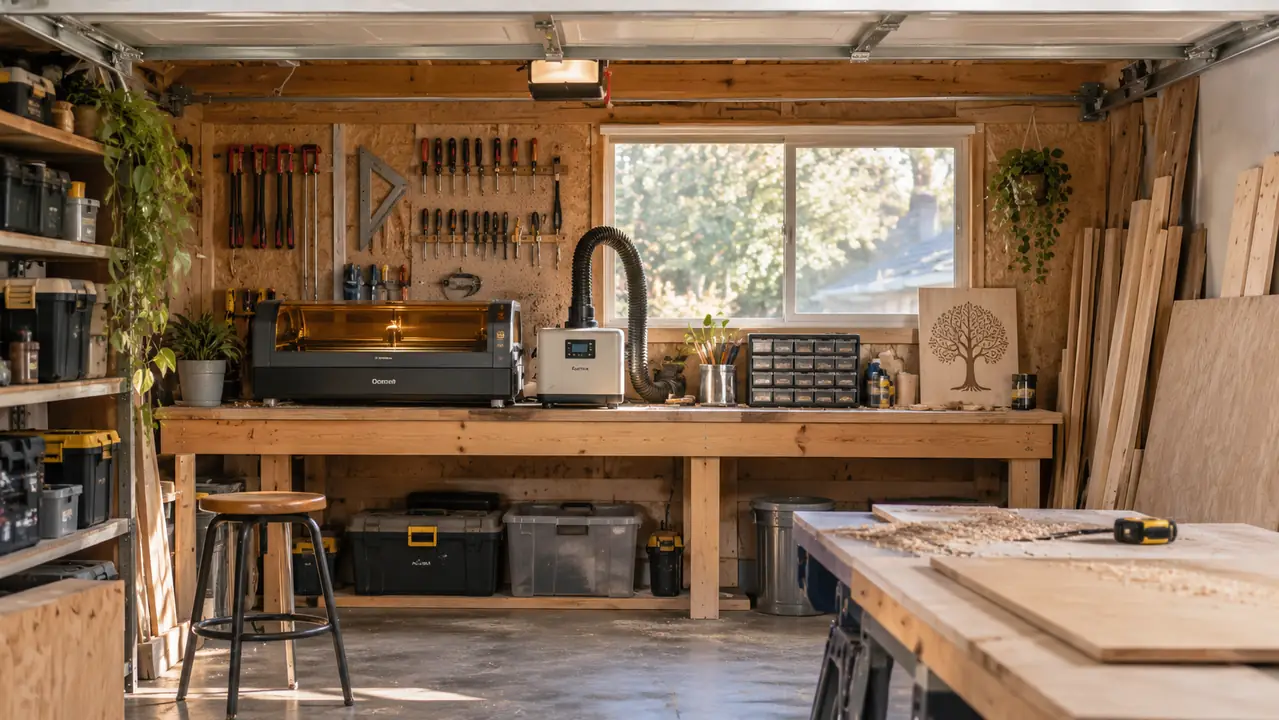
Smoke from a laser engraver does not stay where you put it. I run my machine on a bench along the back wall of a one-car detached garage outside Harrisburg, and for the first two years I relied on an open window and a box fan. That works right up until the wind shifts. Then the whole garage smells like a burnt coffee can, and Carol can smell it from the driveway before she gets to the door.
I added the SainSmart Genmitsu Smoke Purifier in late winter, mostly to stop the smell at the source instead of chasing it out after the fact. I have run it through five months of weekend sessions now, maybe 120 hours of actual engraving, on maple, walnut, slate, leather and stainless. It is not a whole-garage air cleaner and it will not replace your venting. What it does, it does well enough that I keep using it every session. Here is the honest version, including the parts I do not like.
The Quick Verdict
A compact at-the-source smoke catcher that makes light weekend engraving much more pleasant, provided you keep venting the garage and keep the unit close.
Amazon Check Today's Price →Stop breathing your engraving smoke: see today's price on the SainSmart Genmitsu Smoke Purifier
Compact, five-layer filtration, three speeds, and a push-button control that takes ten seconds to learn. It sits on the bench beside the laser, which is exactly where you want it.
Amazon Check Today's Price on Amazon →How I've Used It
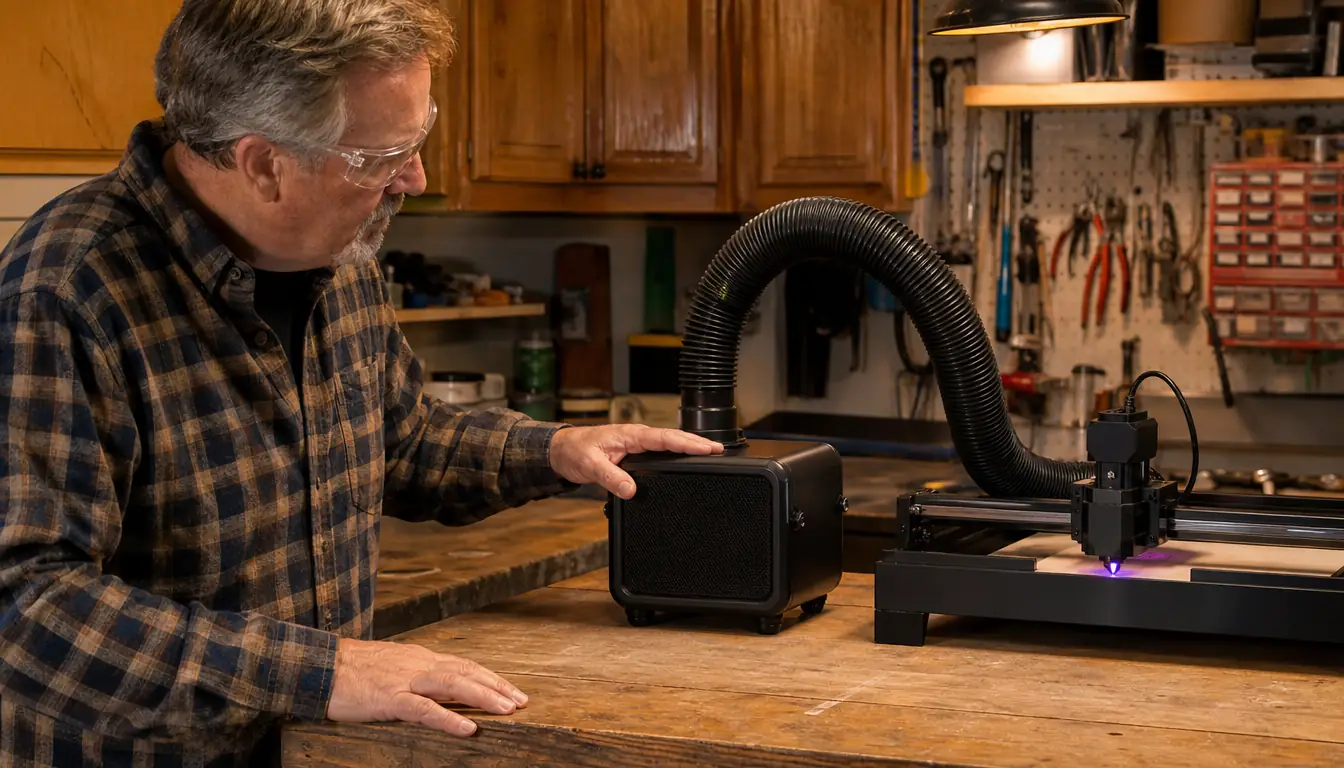
The unit lives on the right side of my workbench, about 18 inches from the laser bed, aimed at the point where the beam meets the material. It is small, 4.72 inches deep, 4.33 inches wide and 3.94 inches high, and it weighs 1.8 kg. That sounds tiny for a smoke problem, and it is. The trick is proximity. A small extractor right at the cut pulls smoke before it spreads. A big fan across the room just stirs it and pushes it past your face on the way to the window.
Most Saturdays I run four to six hours, with a lunch break. Sundays are lighter, two or three hours. I engrave maple cutting boards, slate coasters, leather keychains, and the occasional stainless tumbler. The smelliest jobs are leather and the darker woods. The dustiest are slate. I turn the unit on before the first job, leave it running between jobs, and let it run for a few minutes after I finish. Leather and dense walnut get the high setting. Maple and slate get medium. Low is for short keychain runs or for the last few minutes of cleanup when I am just clearing the bench.
I still vent through the window. That has not changed. The Genmitsu is an addition, not a replacement. If you are looking for one unit that will clean a two-car garage, this is not that unit. If you want to stop the plume at the source so your shop does not fill up in the first place, this is the right shape of tool. I crack the window, run the box fan on low to keep air moving out, and let the purifier work at the bench. The two together do a better job than either one alone.
What the Five-Layer Filtration Actually Does
The listing calls it a five-layer filter system, and the layers that matter in a laser shop are the pre-filter, the HEPA layer and the activated carbon. The pre-filter catches the bigger debris. The HEPA layer is rated to 0.3 microns, which is the number I care about because laser smoke is fine particulate. Fine particulate is what hangs in the air, drifts into the house, and settles on everything you own. The carbon is what handles odor. The specs also list cigarette smoke, dust, odors and pet dander as contaminants it is built to handle. I cannot test pet dander because we do not have pets, but I can tell you it handles the burnt-leather smell and the sharp edge of scorched walnut.
The carbon is the layer that fades first. By late spring I could smell leather again before the filter looked dirty. That is the carbon telling you it is done, not the HEPA. I check the pre-filter every few sessions and tap it out over the trash. The main filter gets replaced when the smell comes back on a job that used to run clean. That is not a scientific test, but it is the one that matters in a garage. A filter gauge would be nice. I do not have one, so my nose is the gauge.
The 0.3 micron rating is the reason I bought this instead of a cheaper fan with a foam pad. A foam pad catches the visible haze. It does not catch the part that makes you cough two hours later. I am not a lab, and I am not going to pretend I measured the exhaust with a particle counter. I am a retired HVAC technician, so I know what a filter is supposed to do, and I know when a room feels different. After a four-hour Saturday, the garage feels different.
On a four-hour Saturday of engraving walnut, the smell went from Carol noticing it from the driveway to nothing until I lifted the lid on the laser.
Three Speeds, and How I Pick One
The control is a push button. You cycle through three speeds and that is the whole interface. I like that in a shop. Gloves on, dust on my hands, one button. No menu to scroll through, no app to connect, no settings to remember. SainSmart kept it simple, and simple is what survives a garage.
Low is for a ten-minute keychain run or when I am standing right there with a small job. Medium is my default for maple, slate and most cutting boards. High is for leather, dense walnut, long sessions, or a cold morning when the garage door is closed and the air is still. On high the unit is working hard, and you can hear it. On medium it fades into the background. On low it is barely there. The speed setting changes how much air moves, not what the filter catches. The filter is the same either way.
SainSmart rates the noise at 35 dB. At low speed that feels about right. On high it is louder than the rating suggests, at least in my garage, but it is still not a shop vac. I can hear the laser fan. I can talk to Carol when she comes out to check a design. I can hear my phone ring. That is the practical test. If a tool is so loud that you avoid turning it on, you will not use it. This one I use.
Where It Falls Short
The first limitation is the one you can see in the dimensions. This is a compact unit with a small intake, and it only works when it is close to the cut. If it sits three feet away on the end of the bench, it is decoration. I tried it there once, on a slate run, and the smoke drifted past it like it was not there. Move it to 18 inches and it earns its place. That is the trade. You give up floor space right next to the machine.
The second limitation is the whole-garage job. This will not clear a garage after the fact. If you walk in after a long session and the air is already thick, a compact purifier is not going to fix it in five minutes. It is a source-control tool, not a room air cleaner. My box fan moves more total air. The difference is that the box fan pulls smoke across my face on the way out. The Genmitsu catches it at the bench before it gets that far.
The third limitation is filters. They are a consumable, and you have to treat them that way. I check the pre-filter often and replace the main filter when the smell returns. If you are the kind of person who will run a loaded filter for a year because it still turns on, this is not the tool for you. A loaded filter is worse than no filter because you think you are protected. The filter is the whole point. The fan is just the delivery system.
High speed is loud enough that I do not leave it on all afternoon if I do not need it. The unit also gets warm on the outside after a long run, which is normal for a fan and a motor in a small housing, but it is worth knowing. I keep it on the bench, not on a shelf above the work, and I keep the intake clear. Those are small things. They are also the difference between a tool that lasts and a tool that gets shoved under the bench.
Five Months In: What Held Up
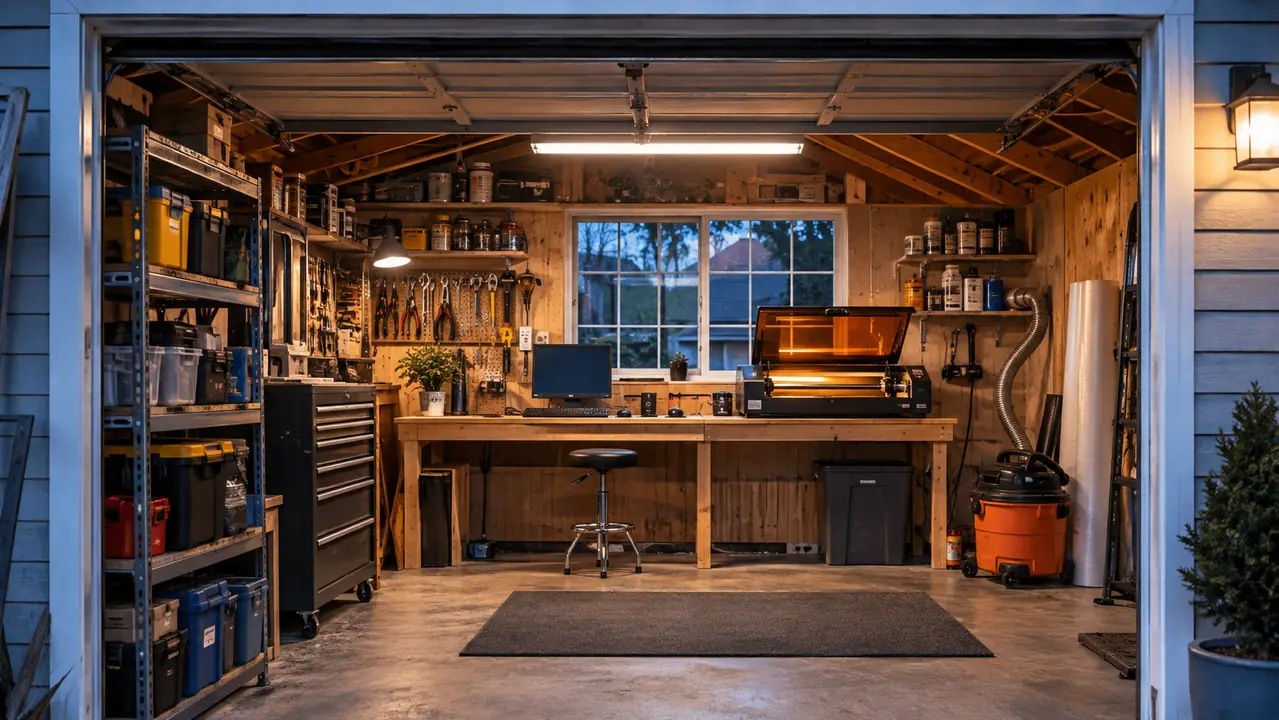
Five months in, the housing has stayed tight. The button has not gotten sticky. The unit has been bumped, dusted, moved from the bench to a shelf and back, and it still starts on the first press. I have not had a rattle or a weird bearing noise. That is not a dramatic endorsement. It is the kind of thing you want from a shop tool. I do not think about it. I turn it on, I work, I turn it off.
The real test came in July, when I did a run of 40 slate coasters for a church bazaar over two weekends. Slate dust is nasty. It gets into everything. I ran the unit on medium the whole time and still wore a respirator when I was handling the blanks and cleaning the edges. The bench stayed clear. The garage did not have that grit-in-the-air feeling. Carol came out on the second Saturday to help pack the finished coasters, and she did not say a word about the smell. That is the highest praise this thing gets.
Maintenance is simple. I tap out the pre-filter, wipe the outside, and keep the intake clear. I wish the filter change were easier to judge, because smell is the only gauge I have. A little indicator would be nice. That is a wish, not a deal breaker. The work is not complicated. It is the same as changing a furnace filter. If you can do that, you can do this.
What I Liked
- Compact and portable, at 4.72 by 4.33 by 3.94 inches and 1.8 kg
- Five-layer filtration with a 0.3 micron HEPA layer and activated carbon
- Three speeds with a simple push-button control
- Rated at 35 dB, quiet enough to leave running on low and medium
- Makes a real difference when placed close to the laser cut
Where It Falls Short
- Small intake means it must sit close to the work
- Will not clear a whole garage after the fact
- Filters are a consumable and the carbon fades before the HEPA looks dirty
- Louder on high than the 35 dB rating suggests
- No filter gauge, so smell is your only warning
Who This Is For
This is for the weekend engraver who works in a garage, a spare room or a shed and wants to knock down smoke at the source. It suits a one-car garage, a bench by a window, short to medium sessions, and someone who will actually keep the unit close to the cut. It also suits soldering and small welding jobs, which the listing mentions. I have used it for a few soldering jobs on jigs, and it pulled the flux smell down the same way it pulls laser smoke down. If you run a desktop laser cutter and you are tired of the garage smelling like a campfire, this is the right first step.
It is also a good fit if you already vent through a window and want to stop the smoke before it crosses the room. It is not a fit if you want to skip the venting. The two work together. I would buy it again for my setup, and I would buy it before I bought another gadget for the bench.
Who Should Skip It
Skip it if you expect one compact unit to clean a whole garage. It will not. Skip it if you run a production shop with a laser going eight hours a day. You need a proper ducted extraction system, not a portable unit. Skip it if you will not change filters. A loaded filter is a false sense of security. And skip it if you want a set-and-forget tool that decides its own speed. This one has a button. You pick a speed and you live with it.
I would also skip it if your only problem is occasional light smoke and you already have strong cross-ventilation. In that case, open the window, run the fan, and save your bench space. The Genmitsu earns its place when the smoke is consistent, when the garage is closed up, or when someone else in the house can smell your hobby. That is when a source-control unit stops being a nice-to-have.
If your garage smells like a campfire after a Saturday of engraving, start here
The SainSmart Genmitsu Smoke Purifier is a compact, five-layer, three-speed unit that works best 18 inches from the cut. Keep venting. Keep the filter fresh. Enjoy the bench again.
Amazon Check Today's Price on Amazon →